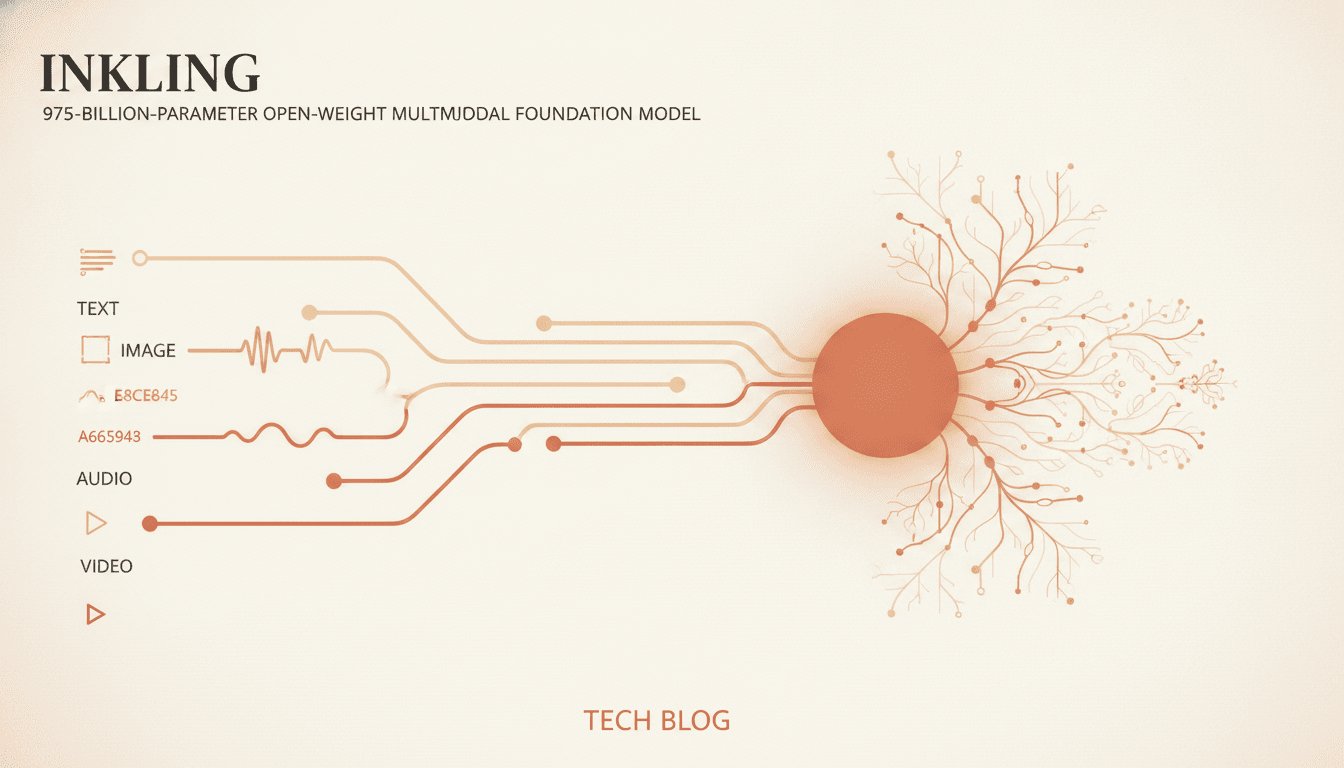
Thinking Machines has released Inkling, an open-weight model trained from scratch, with full weights published simultaneously. The company positions it as a "customizable multimodal foundation model" rather than a model chasing top spot on any single benchmark.
Alongside Inkling, the team also previewed the lighter Inkling-Small (12B active parameters), the first small-size variant in the family.
Core Specs
Two sizes of the same MoE architecture. Donuts show active params per token as a share of total params.
~4.2% active per token
- Architecture
- MoE Transformer
- Context
- up to 1M tokens
- Pretraining
- 45T tokens (text / image / audio / video)
- Weights
- Hugging Face, incl. NVFP4 checkpoint
~4.3% active per token
- Architecture
- MoE Transformer
- Context
- not disclosed
- Pretraining
- similar recipe, data & recipe optimized
- Weights
- after testing completes
Core Capabilities
Inkling's emphasis is not on being the strongest on any single dimension, but on breadth and customizability. The team trained it across agentic tasks, reasoning, coding, instruction following, factuality, vision, and audio, aiming to make it a foundation model that can be fine-tuned into a variety of workflows. Per-dimension benchmark data is detailed in the "Benchmark Performance" section below.
Agentic Coding and Tool Use
Inkling is designed to run across multiple coding / agent harnesses. During training, the tool sets and schemas were randomized to reduce sensitivity to any specific harness. The team showcased several categories of demos:
- Single-pass web app generation: generated a job-application web page from a prompt, then invoked a browser agent to auto-fill the form using a saved resume.
- Design Arena: on a blind human-evaluation Agentic Web Dev leaderboard, Inkling ranks among the top open-weight models.
- Consistent multi-page documents: generated a 9-page PDF food-and-travel journal from a prompt.
- Long-iteration game optimization: with GPT Codex acting as reviewer, Inkling produced a multiplayer online Snake game over 40 rounds of feedback iteration.
Controllable Thinking Effort
Inkling supports tuning an effort parameter to balance performance against token consumption. The team ran an effort sweep (effort from 0.2 to 0.99) on Terminal Bench 2.1, HLE (Humanity's Last Exam), and IFBench. The overall trend: Inkling generates fewer tokens to reach an equivalent score. For example, on Terminal Bench 2.1, Inkling reaches the same score as Nemotron 3 Ultra using roughly one-third the tokens.
Drag the effort parameter to see how the two move relative to each other. Curves are schematic, not official per-point data.
The official effort sweep (0.2 → 0.99 on Terminal Bench 2.1 / HLE / IFBench) shows rising returns with effort, while token cost grows faster; Inkling needs fewer tokens to reach an equivalent score.
Multimodal Capabilities
Inkling natively supports text, image, and audio input. The vision and audio components use an encoder-free architecture: audio uses dMel spectrograms, images are tiled into 40×40 pixel patches, and both pass through a lightweight embedding layer before being processed jointly with text tokens.
The multimodal benchmark comparisons provided by the team are as follows (all at effort=0.99):
Switch between vision and audio; click a legend item to hide a model, hover a vertex for values.
Epistemics
Thinking Machines groups calibration, instruction following, and censorship resistance under the collective term "epistemics."
- Calibration: Inkling's results on ForecastBench and Prophet Arena fall in the same range as models like GPT-5.5 and Gemini 3.1 Pro.
Colors are normalized within each row; Prophet Arena is a Brier score where lower is better (color direction inverted); ± ranges omitted.
- Instruction following and factuality: post-training used two automated graders — a rubric grader and a claims grader. The latter invokes search to verify factual claims, reducing hallucination.
- Censorship resistance: on Cognition's Propaganda and Censorship Eval, Inkling exhibited strong censorship-resistant behavior.
Safety
Colors are normalized within each row. FORTRESS (Adversarial) measures harmful-request refusal; (Benign) measures low over-refusal.
The team states that Inkling has a high refusal rate for harmful requests on FORTRESS while maintaining a low false-refusal rate for benign requests.
Benchmark Performance
All scores below were measured at effort=0.99, temperature=1.0; coding evaluations used a max-token trajectory limit of 256K.
Colors are normalized within each row so different scales stay comparable; coding evals used a 256K max-token trajectory.
Inkling's remaining scores
Values are percentages. SimpleQA Verified comparison: DeepSeek V4 Pro 57.0%, Gemini 3.1 Pro 77.3%, Claude Fable 5 68.3%, GPT 5.6 Sol 71.6%. AA Omniscience scored 2.1 (not a percentage; omitted from the chart).
- StrongREJECT (safety):98.6
- FORTRESS Benign (safety):95.9
- VoiceBench (audio):91.4
- Global-MMLU-Lite:88.7
- Charxiv RQ + Python (vision):82
- IFBench (instruction):79.8
- Charxiv RQ (vision):78.1
- FORTRESS Adversarial (safety):78
- MMAU (audio):77.2
- MMMU Pro (vision):73.5
- Audio MC (audio):56.6
- SimpleQA Verified (factuality):43.9
Training and Architecture
Architecture
Inkling's MoE design draws primarily from DeepSeek-V3:
- 256 routed experts + 2 shared experts per layer; 6 routed experts activated per token
- Sigmoid-based router + auxiliary-loss-free load-balancing bias
- Attention: sliding-window layers interleaved with global layers at a 5:1 ratio; 8 KV heads
- Uses relative positional embeddings rather than RoPE
- Short convolutions added after the attention key/value projections and before the residual branch output
Highlighted cells are the routed experts active for the current token; a new batch lights up every ~2s to simulate incoming tokens.
~4.2% active per token.
- routed expert (active)
- routed expert (idle)
- shared expert (always on)
Per Inkling's official disclosure: 256 routed + 2 shared experts per layer, with 6 routed experts activated per token.
Training
- Pretraining: 45 trillion tokens, covering text, image, audio, and video
- Optimizer: Muon for large-matrix weights, Adam for all other parameters
- Learning rate and weight decay coupling: weight decay magnitude is tied to the square of the learning rate, keeping weight scale stable
- Post-training: covers math, agentic code and tool use, audio, image, conversation, safety, and other domains
- Post-training starts with synthetic-data SFT (including data generated with Kimi K2.5), followed by large-scale RL
Large-Scale RL
Inkling's post-training relies on large-scale asynchronous RL, accumulating over 30 million rollouts. The aggregate eval reward reported by the team rises from 0.264 at SFT initialization to 0.356 at the release checkpoint (~26.5 million rollouts); on aggregate metrics across reasoning benchmarks (AIME, HLE, GPQA), reward improves log-linearly with rollout count.
During RL, the model's chain-of-thought became shorter and more telegraphic — dropping articles and conjunctions, while remaining comprehensible and without affecting the final answer. The team showed a before/after CoT comparison on a math-physics problem: early-stage (full grammar) vs. late-stage (compressed, telegraphic).
Inkling-Small
Inkling-Small is the lightweight preview of the same model family: 276B total parameters, 12B active. Thanks to optimized pretraining data and recipe, it approaches or matches Inkling on many benchmarks.
Each dot is a benchmark: x = Inkling, y = Inkling-Small. Above the diagonal means Small wins; below means Inkling leads. Hover for details.
Most dots hug the diagonal — Small is close to Inkling overall; SimpleQA, Tau 3 Banking, and Terminal Bench 2.1 are the few notable laggards.
The team states that Inkling-Small is suited for cost- and latency-sensitive scenarios such as coding, LLM-as-judge scoring, and synthetic data generation. Full weights will be released after testing completes.
Customization and Availability
A key direction for Inkling is customizability:
- Now available on the Tinker platform with fine-tuning support
- Context length selectable at 64K or 256K
- Limited-time 50% discount (full pricing in official docs)
- Tinker console adds Inkling Playground with a free trial period
- Updated cookbook with new recipes targeting Inkling's audio capabilities
- Released
tml-rendererfor reliably sampling and handling tool calls, reasoning content, and multimodal input
The team also demoed Inkling self-fine-tuning: the model writes its own fine-tuning job, runs it, and evaluates the results.
Ecosystem Integration
- API: TogetherAI, Fireworks, Modal, Databricks, Baseten
- Inference frameworks: SGLang / Miles (RadixArk), vLLM (Inferact), TokenSpeed (Lightseek), llama.cpp (Unsloth), Hugging Face transformers
- Weights: Hugging Face (original checkpoint + NVFP4 checkpoint, optimized for NVIDIA Blackwell)
Reference Links
- Official release blog (2026-07-15): https://thinkingmachines.ai/news/introducing-inkling/
- Model card: https://thinkingmachines.ai/inkling
- Hugging Face weights: https://huggingface.co/thinkingmachines
- Tinker platform: https://tinker.thinkingmachines.ai