16 AI Coding Subscriptions, Head-to-Head — Price, Models, and Quota Semantics
By mid-2026, you could already subscribe to more than fifteen AI coding plans. Model vendors folded coding into their general-purpose assistant tiers; in-house shops launched dedicated Coding Plans; aggregators bundled several open-source models under one price; and a few IDE-style subscriptions rounded things out — sixteen choices in front of the developer.
Monthly fees run from ¥19 to $200, two orders of magnitude apart. But the sticker price alone can't answer "is it worth it": every vendor defines "usage" differently — some count requests, some bill in dollar allowances, some say only "5x usage" without disclosing the numbers. This article unpacks all sixteen across three layers — price, model sourcing, and quota semantics. Data comes from each vendor's official pricing page (snapshot 2026-06-30); OpenRouter pay-as-you-go rates are used to back out the underlying token cost.
First, three subscription archetypes
These sixteen aren't selling the same thing, and their pricing logic differs too.
Model vendors' general-purpose assistant subscriptions (Claude, ChatGPT, Gemini, Kimi) treat coding as one perk inside a bundle: Claude Code, Codex, AI Studio/Jules extended allowances, Kimi Code. What you pay for is "more usage" — but that usage is often a black box.
Dedicated Coding Plans split into two camps. The in-house camp runs on the vendor's own flagship: GLM Coding Plan (Zhipu) and MiMo Token Plan (Xiaomi), both with clear pricing gradients — MiMo from Lite at ¥39 up to Max at ¥659, GLM from Lite at ¥49 to Max at ¥469. The aggregator-relay camp bundles multiple open-source models and resells them: iFlytek, Volcano Ark, and Alibaba Cloud Bailian all aggregate GLM, Kimi, DeepSeek, Qwen, and MiniMax, with the differences concentrated in their respective flagship in-house models — iFlytek offers Spark X2, Volcano offers Doubao Seed-2.0-Code, Alibaba offers Qwen.
Open-source aggregator subscriptions (Cline Pass, OpenCode Go) bundle multiple open-source models at a single price; in essence they package model selection and quota management so users don't have to care about the underlying token price. MiMo is one of the standard-config models for both.
The remaining four are, strictly speaking, a fourth archetype — IDE-style subscriptions selling the dev environment and completion experience. Cursor, Windsurf (now Devin Desktop), and GitHub Copilot aggregate frontier models under the hood; Qoder (formerly Tongyi Lingma) runs its in-house Qwen route. They're included here as reference points.
Mid-tier monthly fees: two orders of magnitude
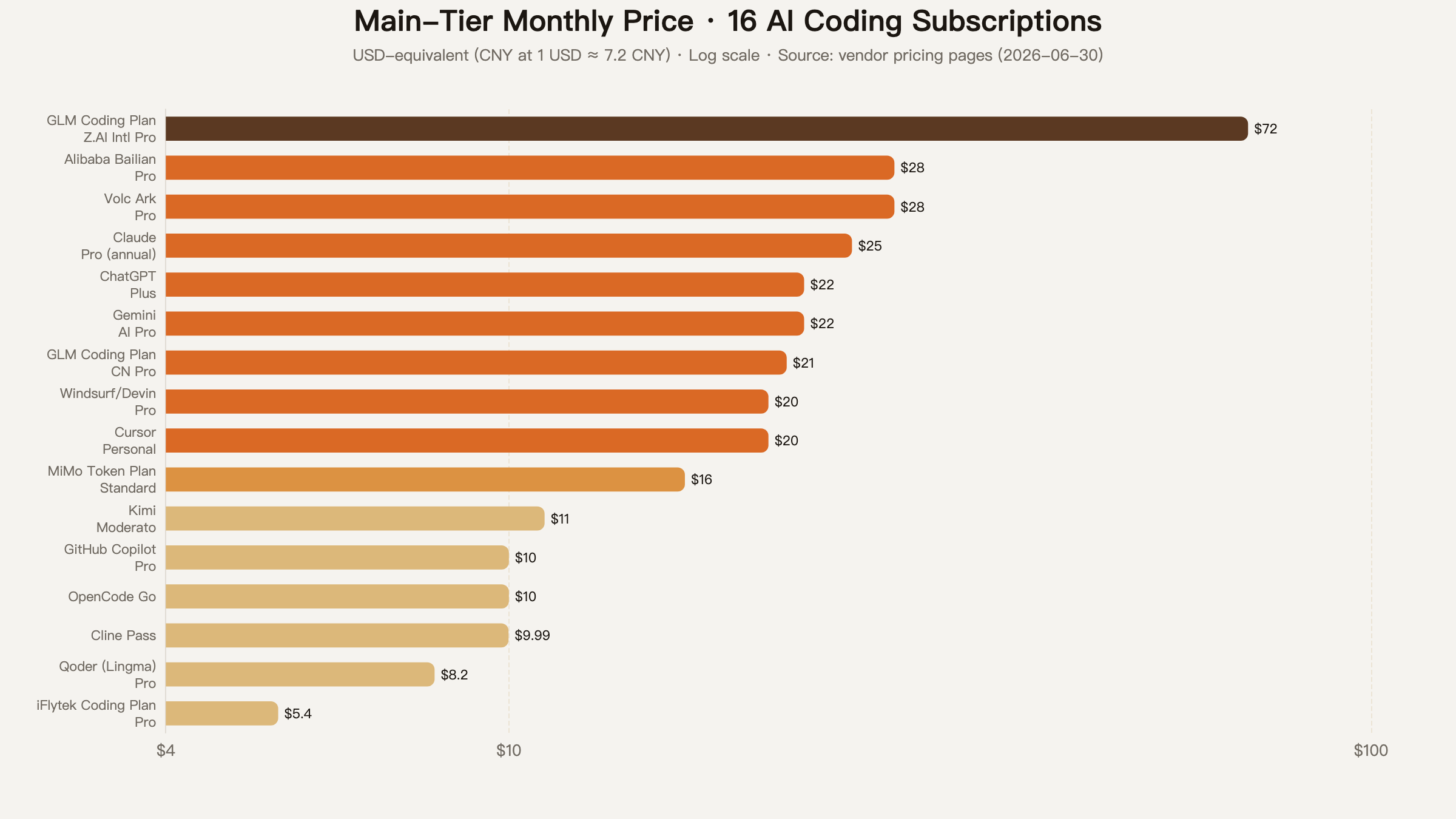
A comparison of each vendor's "main tier" (the one between entry and top-spec, aimed at everyday development), sorted by USD-equivalent price from low to high:
| Vendor | Main tier | Monthly fee | Model source | Quota basis |
|---|---|---|---|---|
| iFlytek Coding Plan | Pro | ¥39 (≈$5.4) | Aggregated | Requests / 5h |
| Qoder (formerly Tongyi Lingma) | Pro | ¥59 (≈$8.2) | In-house Qwen | Credits |
| Cline Pass | Single tier | $9.99 | Aggregated, 6 open-source | Quota multiplier (black box) |
| OpenCode Go | Single tier | $10 | Aggregated, 13 open-source | USD allowance |
| GitHub Copilot | Pro | $10 | Aggregated | AI Credits |
| Kimi | Moderato | ¥79 (≈$11) | In-house K2.7 Code | Unified Credits pool |
| MiMo Token Plan | Standard | ¥99 (official overseas price $16) | In-house MiMo-V2.5 | Credits |
| GLM Coding Plan (China) | Pro | ¥149 (≈$21) | In-house GLM-5.2 | Requests / 5h |
| Cursor | Individual | $20 | Aggregated frontier | Dual usage pools |
| Windsurf/Devin Desktop | Pro | $20 | Aggregated frontier | Usage allowance (black box) |
| Gemini | AI Pro | ≈$22 (28.99 SGD) | In-house Gemini 3.1 Pro | Usage allowance |
| ChatGPT | Plus | ≈$22 (30 SGD) | In-house GPT-5.5 | Black box (multiplier) |
| Claude | Pro | $25 (annual) / $30 (monthly) | In-house Opus/Sonnet | Black box (multiplier) |
| Volcano Ark | Pro | ¥200 (≈$28) | Aggregated | Requests / 5h |
| Alibaba Cloud Bailian | Pro | ¥200 (≈$28) | Aggregated | Requests / 5h |
| GLM Coding Plan (Z.AI international) | Pro | $72 | In-house GLM-5.2 | USD allowance / 5h |
Entry tiers show the floor more clearly: iFlytek's unlimited tier at ¥19/month with no request cap is the lowest-threshold plan among the sixteen, followed by MiMo Lite at ¥39/month ($6 overseas) and GLM China Lite at ¥49/month. Top-spec tiers live in another magnitude entirely: Windsurf/Devin Max at $200/month is the highest sticker price, followed by Claude Max 5x (from $149.99), Gemini AI Ultra (from 139.99 SGD, ≈$104), GitHub Copilot Max ($100), MiMo Max (¥659, $100 overseas), Kimi Allegro (¥559, ≈$78), and GLM China Max (¥469, ≈$65).
But the monthly fee only tells you how much you pay — not how much model compute you get back. For that, you need the quota basis.

Quota basis: four classes, mutually non-interchangeable
This is the most important — and most easily overlooked — section of this article. Vendors' usage definitions fall into four classes that aren't directly convertible across vendors.
| Basis | Meaning | Adopted by |
|---|---|---|
| A. Request count | One question = one count; internally the model may be invoked multiple times | GLM China, iFlytek, Volcano, Alibaba |
| B. USD-value allowance | Token consumption is converted to USD at the official pay-as-you-go rate | OpenCode Go, GLM international (Z.AI), Cursor (API pool) |
| C. Credits / unified pool | Platform-defined points; different models deduct at different coefficients | MiMo, Kimi, GitHub Copilot, Qoder |
| D. Multiplier description (black box) | Only a relative multiplier like "5x / 20x / 2–5x"; token counts not disclosed | Claude, ChatGPT, Windsurf, Cline Pass |
In class A, iFlytek and Alibaba give the exact same conversion note: "Each question deducts allowance based on the actual number of model invocations — simple tasks consume about 5–10, complex tasks about 10–30+." GLM gives a firmer anchor: the official wording is "one prompt is expected to invoke the model 15–20 times," and it also promises "monthly available allowance, converted at API pricing, equals 15–30× the subscription fee."
Class B is the only one in which token counts can be computed exactly. OpenCode Go's $60/month allowance comes with official per-model estimated monthly request counts: GLM-5.2 about 4300, Kimi K2.7 Code about 9250, Qwen3.7 Plus about 21600, DeepSeek V4 Flash about 158150. Combined with the official pay-as-you-go price table (GLM-5.2 input $1.40 / output $4.40; DeepSeek V4 Flash input $0.14 / output $0.28), users can back out the actual token volume per call.
In class C, MiMo is the most forthcoming: it publishes per-token Credit consumption coefficients (mimo-v2.5-pro output 600 Credits/token, uncached-input 300 Credits/token) and gives a verifiable example — the Lite plan has 4.1B Credits; after consuming 10M uncached input tokens of mimo-v2.5-pro (deducting 3000M Credits), 1100M remain (4100M − 3000M = 1100M; the official figure is self-consistent).
Class D is pure black box. Claude's site says only "5x or 20x Pro usage" with no token or message count; ChatGPT Pro describes its quota as "unlimited*" with the asterisk pointing to anti-abuse rules; Cline Pass says only "2–5× the standard API limit." Before buying any of these three, there's no way to compute from the official site how many calls you'll get — you can only judge from actual use.
Cursor sits in between: it gives no token count, but it does publish typical-user spending ranges — the only "roughly how much does a typical user spend" official estimate among the sixteen. Users who only use Tab completion daily usually stay under $20; daily Agent users typically land at $60–100/month in total; heavy users (multiple Agents or automation) usually exceed $200.
One more detail worth flagging in class A: GLM applies a coefficient to its flagship GLM-5.2 calls — "3× during peak, 2× off-peak" (peak window is 14:00–18:00 daily, UTC+8). As a limited-time perk, off-peak is temporarily billed at 1× through the end of September. The same plan can do substantially more work if you avoid the afternoon peak.
Underlying token price: Chinese flagships stable at $3–4/M
The reason Coding Plans can deliver "high volume, flat-rate" rests on the pay-as-you-go unit price of the model. Below is the main cost in coding scenarios — the output price — tiered using OpenRouter data:
Tier 1 ($12–180/M): GPT-5.5 Pro ($180, the most expensive in the table), GPT-5.5 ($30), Claude Opus 4.8 ($25), Claude Sonnet 5 (launch-promo price $10 through 8/31, reverting to $15 from September), Gemini 3.1 Pro ($12).
Tier 2 ($3–5/M): Claude Haiku 4.5 ($5), GLM 5.2 ($3), Kimi K2.7 Code ($3.5), Qwen3.7 Max ($3.75).
Tier 3 ($1–1.5/M): MiniMax M3 ($1.2), Qwen3.7 Plus ($1.28), MiMo-V2.5-Pro and DeepSeek V4 Pro (both $0.87 — their input price $0.435 and cache-read price $0.0036/M are also identical, suggesting shared hosting or price alignment).
Floor (≤$0.3/M): MiMo-V2.5 ($0.28), DeepSeek V4 Flash ($0.18).
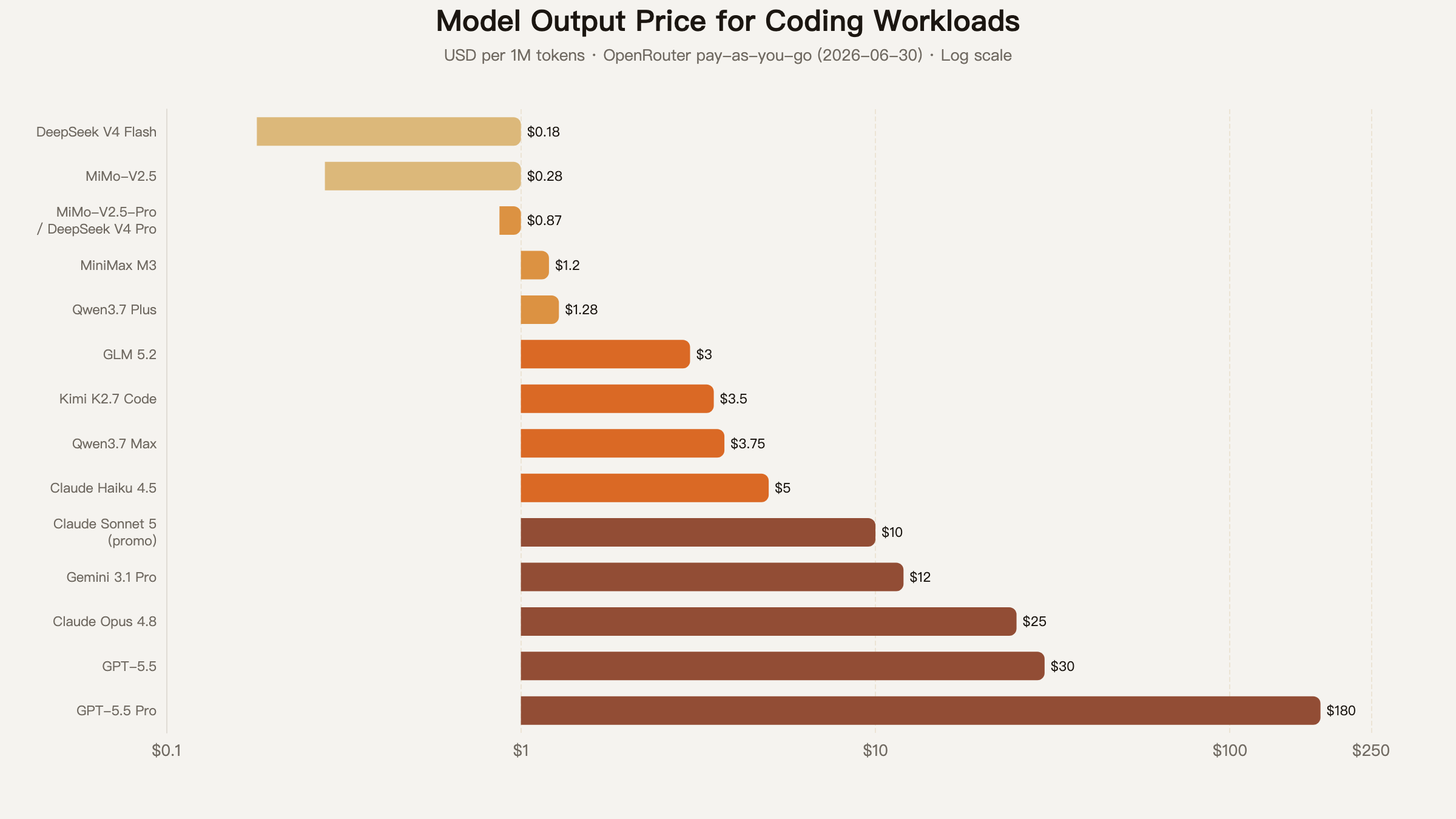
The Chinese flagships (GLM 5.2, Kimi K2.7 Code, Qwen3.7 Max) have settled at $3–4/M output — roughly one-fifth of Claude Sonnet's standard price and one-tenth of GPT-5.5. That is the price foundation that makes cheap monthly Coding Plans possible: pay-as-you-go is already cheap, and the monthly plan dilutes the cost basis further.
Sonnet 5 is a new model released 2026-07-01; its promo-period output price of $10/M lands between Claude Haiku 4.5 ($5) and the previous-generation Sonnet 4.6 ($15) — the only model in tier 1 to hit that price band during its promo window. The vendor also switched to a new tokenizer: identical text produces 1.0–1.35× the tokens of the old version, so during the promo period the actual per-task cost is even lower. From September 1 the standard price of $15/M resumes.
Gemini's output price has an easily-missed detail: the vendor bills internal reasoning (thinking) tokens at the same rate as output, so long-thinking-chain scenarios cost noticeably more than the nominal $12/M.
Cache-read price differences are equally worth noting — a key variable in coding scenarios with lots of repeated prompts. MiMo-V2.5-Pro and DeepSeek V4 Pro go as low as $0.0036/M, about 1/120 of the input price; mainstream models like Claude and Gemini typically price cache reads at 1/10 of input; Kimi K2 Thinking's cache-read price equals its standard input price — no cache discount at all. Under long-context repeated-prompt workloads, this gap alone can move the actual bill by an order of magnitude.
A few specific observations
The direction of international-vs-domestic price gaps is not consistent across vendors. GLM China (bigmodel, Pro ¥149/month) is 3.5× cheaper than the international site (Z.AI, Pro $72, ≈¥518 at roughly 7.2 RMB per dollar). MiMo is the opposite: the official domestic-vs-overseas pricing, after conversion, isn't a simple 1:1 — overseas tiers come out 9%–16% more expensive than their domestic counterparts in RMB (Lite ¥39 corresponds to overseas $6, ≈¥43; Max ¥659 corresponds to overseas $100, ≈¥720), yet mimo-v2.5's overseas pay-as-you-go output price is only $0.28/M — still among the lowest in the table. Both Chinese vendors — opposite overseas-pricing strategies.
The aggregator-relay camp is highly homogeneous. iFlytek, Volcano, and Alibaba aggregate essentially the same roster — GLM, Kimi, DeepSeek, Qwen, MiniMax — with differences concentrated in their respective flagship in-house models and pricing gradients. Volcano and Alibaba's Pro tiers are priced identically (¥200/month), and their quota limits match exactly (6000 per 5 hours, 45000 per week, 90000 per month). iFlytek's Pro at ¥39/month is the cheapest capped plan among the three; its unlimited tier at ¥19/month with no request cap is the floor of the segment. Alibaba's Lite tier stopped new purchases in March 2026 and renewals in April; only the Pro tier remains on sale.
Qoder is the only IDE-style product in this batch on an in-house Qwen route. Renamed from Tongyi Lingma in May 2026 and switched to Credits billing (Pro at ¥59/month, 2000 Credits, first month free), its pricing system differs from both the aggregators above and the Coding Plans — the most fine-grained case among the sixteen.
Industry consolidation is accelerating. Windsurf has been acquired by Cognition (maker of Devin) and is now called Devin Desktop; GitHub Copilot is gradually shifting from a single-model product to a multi-model aggregation platform — its Pro tier already supports third-party agents like Claude Code and Codex; OpenAI Codex itself is not a standalone subscription and is only available via ChatGPT plans or pay-as-you-go API.
How to choose
Lay the prices and bases above onto concrete needs and only a few landable judgments emerge — but all are backed by data.
If you need frontier closed-source models (GPT-5.5 Pro, Claude Opus/Sonnet, Gemini 3.1 Pro), there's no path around it — you must subscribe to Claude Pro/Max, ChatGPT Plus/Pro, or Gemini AI Pro/Ultra. Their usage is black-box or half-black-box, but closed-source flagships are only available here.
For Chinese flagships (GLM 5.2, Kimi K2.7 Code, Qwen3.7 Max, MiMo-V2.5-Pro), in-house Coding Plans have a clear price advantage: GLM China Pro at ¥149/month, Kimi Moderato at ¥79/month, MiMo Standard at ¥99/month — the underlying pay-as-you-go cost is roughly one-fifth of Claude Sonnet's standard price.
If you don't care which model and just want "high volume, flat-rate," open-source aggregator subscriptions are the floor: OpenCode Go ($10/month, $60 USD allowance, with official precise per-model estimated request counts), Cline Pass ($9.99/month), iFlytek's unlimited tier (¥19/month, no request cap). All three list MiMo as one of their standard-config models.
If you need to compute roughly how much each call costs before buying, currently only OpenCode Go (USD allowance + official price table) and MiMo (Credits + per-token coefficient) give enough information in their official docs. GLM provides a fuzzy anchor (15–30× the monthly fee), Cursor provides a scenario-level estimate, and most other subscriptions can only be judged through actual use.
A final note
A few facts from this survey are reasonably clear: monthly fees across the sixteen subscriptions span two orders of magnitude, from ¥19 to $200; the pay-as-you-go output price of Chinese flagships has stabilized at $3–4/M — one-fifth of Claude Sonnet's standard price, one-tenth of GPT-5.5; but quota bases split into four classes that can't be directly converted between, and of the sixteen only OpenCode Go and MiMo publish enough in their official docs to compute exact token counts.
Before buying, it's worth settling one question first: the usage you get in exchange for your monthly fee — is it a number you can compute, or a "plenty of usage" that the vendor has never bothered to define.