We pulled the latest tweets from 36 X accounts operated by 7 frontier-model companies — roughly 50 tweets per account, about 1,600 in total — and combined them with follower counts, lifetime tweet counts, and engagement metrics. From four angles (account matrix, posting cadence, engagement, and content themes), we break down how these companies actually run X.
1. Account Basic Information
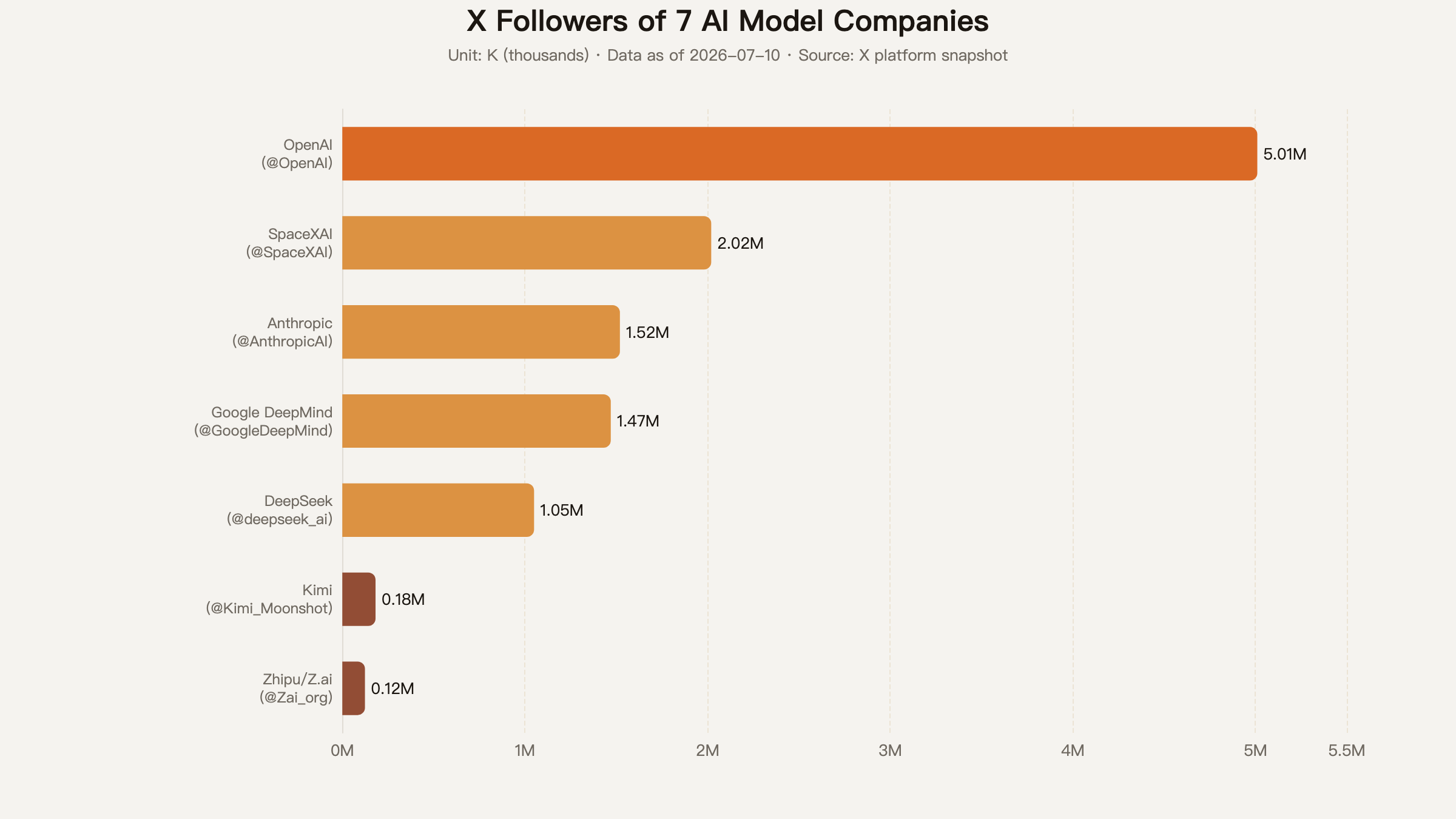
First, how many followers has each company on X?
Follower Scale of Primary Accounts
| Company | Primary account | Followers | Lifetime tweets |
|---|---|---|---|
| OpenAI | @OpenAI | 5.01M | 1,976 |
| SpaceXAI/Grok | @SpaceXAI | 2.02M | 330 |
| Anthropic | @AnthropicAI | 1.52M | — |
| Google DeepMind | @GoogleDeepMind | 1.47M | — |
| DeepSeek | @deepseek_ai | 1.05M | 168 |
| Kimi | @Kimi_Moonshot | 182K | 386 |
| Zhipu/Z.ai | @Zai_org | 124K | 1,202 |
A few facts worth noting:
It is common for product accounts to surpass the company account in followers. Anthropic's @claudeai (1.6M) exceeds @AnthropicAI (1.52M); SpaceXAI's @grok (8.85M) is 4.4× the size of the company's primary account; OpenAI CEO Sam Altman's personal account @sama (5.41M) is on par with the company account. Users are more willing to follow a concrete product or person than a corporate entity.
DeepSeek's account is strikingly minimal. 168 lifetime tweets, following zero accounts, with no sub-accounts or executive accounts — and it has still accumulated 1.05M followers. That figure is 5× Kimi's primary account (182K) and 8× Zhipu's (124K).
Google has the most complex matrix. Five official accounts — DeepMind, GeminiApp, GoogleAI, GoogleAIStudio, GoogleLabs — plus six executive accounts (Demis Hassabis, Sundar Pichai, Jeff Dean, and others). The brand is so dispersed that there is no single unified "Gemini" entry point.
Executive Accounts: The Leverage of Personal IP
The reach of executives' personal accounts is the key variable for understanding these companies' X operations.
| Company | Core executive | Followers | vs. company account |
|---|---|---|---|
| SpaceXAI | Elon Musk (@elonmusk) | 241M | 119× the company account |
| OpenAI | Sam Altman (@sama) | 5.41M | On par with the company account |
| Sundar Pichai | 9.09M | 6.2× DeepMind | |
| Demis Hassabis | 1.36M | On par with DeepMind | |
| Anthropic | Dario Amodei | 480K | 1/3 of the company account |
| Zhipu | Tang Jie (@jietang) | 52K | 1/24 of the company account |
| Kimi | Yang Zhilin | No public account | — |
| DeepSeek | Liang Wenfeng | No public account | — |
Chinese companies are essentially blank on executive personal IP. Among the three, only Zhipu founder Tang Jie has an active X account (52K followers), and it leans academic — he has not built a "product spokesperson" persona. The founders of Kimi and DeepSeek have no public X accounts. A single Sam Altman tweet gets 5–10× the engagement of the @OpenAI company account, and one Elon Musk tweet reaches more than the combined matrices of the other six companies.
2. Posting Cadence: From 3 Tweets a Day to 1 Every Two Months
We estimate posting frequency from the time span covered by each account's 50 most recent tweets. Note that some accounts are sorted by engagement rather than chronologically (X's default behavior), so their frequency figures are approximate.
Posting Cadence of Primary Accounts
| Account | Days covered by 50 tweets | Estimated cadence | Style |
|---|---|---|---|
| @OpenAI | ~22 days | 16/week | Sustained barrage during launch weeks |
| @Zai_org | ~18 days | ~19/week | Recent burst-mode operations (heavy retweets) |
| @GoogleDeepMind | ~48 days | ~7/week | Steady rhythm |
| @SpaceXAI | ~48 days | ~7/week | About one product/partnership per day |
| @AnthropicAI | ~52 days | ~7/week | Synced to product/research milestones |
| @Kimi_Moonshot | ~64 days | ~5.5/week | Product-driven |
| @deepseek_ai | ~850 days | ~1.5/week | Ultra-low frequency, only blockbusters |
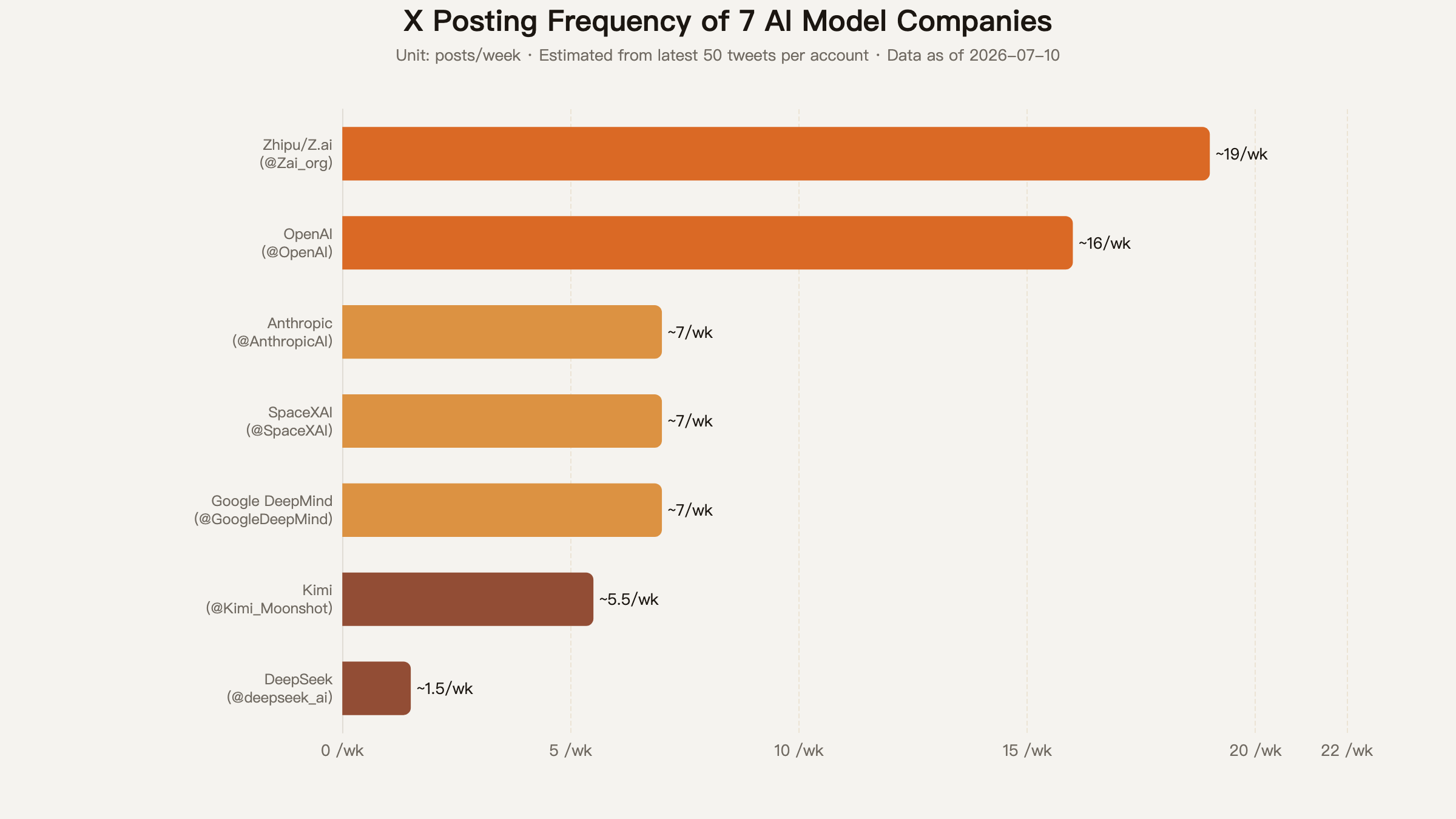
DeepSeek is the extreme case: its 50 most recent tweets span over two years, from February 2024 to April 2026. Its most recent tweet is the API price-cut announcement of April 26, 2026; as of July 10 it has been silent for 75 days. Looking at historical patterns, though, DeepSeek typically goes quiet for months and then releases a blockbuster model in a single burst — both R1 and V3 were one-shot detonations after long silences.
The other extreme is @Zai_org: 50 tweets in 18 days, but more than 70% are retweets of third-party partners announcing support for GLM-5.2.
Thread Mode: One Piece of News Split into 5
Both OpenAI's and Anthropic's primary accounts make heavy use of threads for major announcements. Take OpenAI's GPT-5.6 launch on July 9:
- Main tweet: "Sol, Terra, and Luna, our GPT-5.6 family of models, are starting to roll out now" (10,082 likes)
- Reply 1: Rollout channels and schedule details (1,081 likes)
- Reply 2: Notes on GPT-5.6's improved artifact quality (549 likes)
- Reply 3: ChatGPT Work product intro (16,067 likes)
- Replies 4–6: User stories (a farmer, a mathematician, the cereal family)
A single launch is split into 6–7 tweets: the main tweet detonates the traffic, and the reply thread expands the information.
3. Engagement: What Actually Breaks Out
Engagement varies enormously — from dozens of likes to hundreds of thousands. Below, the highest-engagement tweets are grouped by company.
Overall Top 10 Tweets
| Rank | Account | Content | Likes | Views |
|---|---|---|---|---|
| 1 | @sama | "no thank you but we will buy twitter for $9.74 billion" | 219,672 | 33.74M |
| 2 | @sama | "can yall please chill on generating images this is insane our team needs sleep" | 119,641 | 17.02M |
| 3 | @AnthropicAI | Fable 5 suspended from export control by US government | 88,157 | 92.51M |
| 4 | @deepseek_ai | Anti-impersonation statement: sole official account | 74,491 | 8.23M |
| 5 | @sama | Farewell tweet after being fired during the OpenAI board crisis | 89,225 | 25.96M |
| 6 | @AnthropicAI | Fable 5 export controls lifted | 84,877 | 14.71M |
| 7 | @deepseek_ai | DeepSeek-R1 launch | 35,401 | 12.54M |
| 8 | @OpenAI | GPT-5.6 public launch teaser | 47,728 | 9.35M |
| 9 | @SpaceXAI | xAI → SpaceXAI rename announcement | 29,912 | 3.46M |
| 10 | @Zai_org | GLM-5.2 launch | 13,153 | 7.50M |
Several things stand out:
The engagement ceiling for CEO personal accounts is far higher than for company accounts. Sam Altman's top two tweets (219K and 119K likes) are 4–10× the most-liked @OpenAI company tweet (47K). Elon Musk's historical viral tweets (4.22M likes) are simply in a different league.
Crises drive the most engagement. Anthropic's Fable 5 export-control event chain (suspended June 13 → lifted June 30 → restored July 1) generated the single highest view count in the entire dataset: 92.51M. The attention from a safety/policy crisis far exceeds that of a normal product launch.
DeepSeek's anti-impersonation statement outperformed its model launch. The 74K-like anti-impersonation statement ranked #4, ahead of the R1 launch tweet (35K). This indicates that DeepSeek's brand heat is intense enough that impersonator accounts have proliferated — and the anti-impersonation tweet itself then earned another round of distribution.
Engagement Comparison: The Three Chinese Companies
| Metric | DeepSeek | Kimi | Zhipu |
|---|---|---|---|
| Primary account followers | 1.05M | 182K | 124K |
| Top single-tweet views | 12.54M (R1 launch) | 2.57M (K2.7-Code) | 7.50M (GLM-5.2) |
| Top single-tweet likes | 74,491 (anti-impersonation statement) | 13,972 (K2.7-Code) | 13,153 (GLM-5.2) |
| Tweets with 10K+ likes | ~12 | ~2 | ~1 |
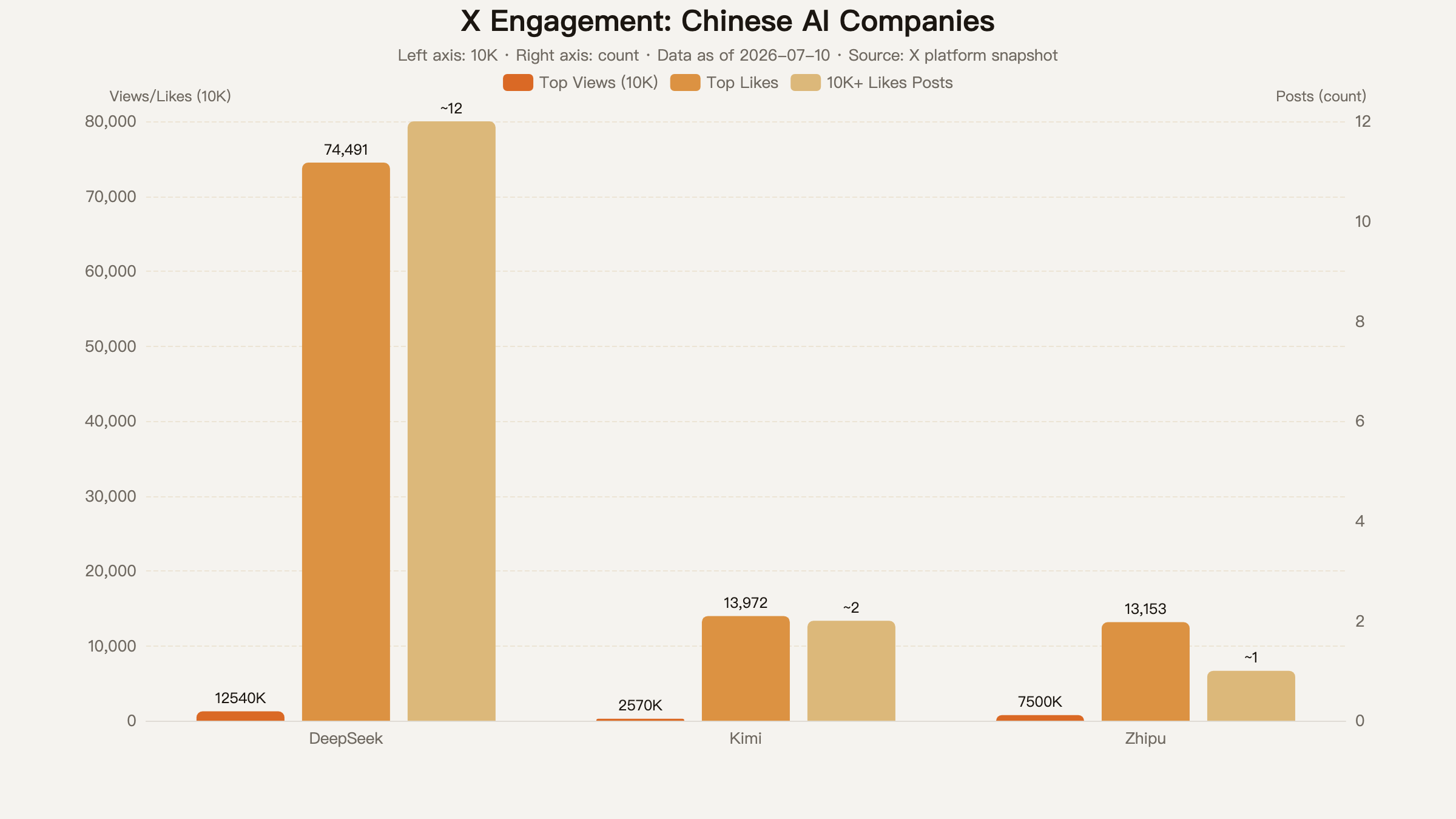
DeepSeek has opened a chasm-level lead in engagement over the other two Chinese companies. A single R1 tweet's views (12.54M) exceed the combined views of all 50 sample tweets from Zhipu and Kimi.
4. Content Themes: What Each Company Pushes
Categorizing the ~1,600 tweets by theme reveals sharp differences in content emphasis.
Content Theme Distribution
| Theme | OpenAI | Anthropic | SpaceXAI | DeepSeek | Kimi | Zhipu | |
|---|---|---|---|---|---|---|---|
| Product launch | 36% | 16% | 24% | 30% | 35% | 30% | 10% |
| Safety/policy | 10% | 30% | — | 15% | 10% | — | — |
| Research/papers | 14% | 20% | — | 25% | 25% | — | — |
| Ecosystem/partnerships | — | — | 40% | 15% | — | 15% | 70% |
| Use Case | 12% | 10% | 10% | 20% | — | 5% | 5% |
| API/pricing | — | — | — | — | 15% | 15% | 5% |
| Open source | — | — | — | — | 25% | 10% | 5% |
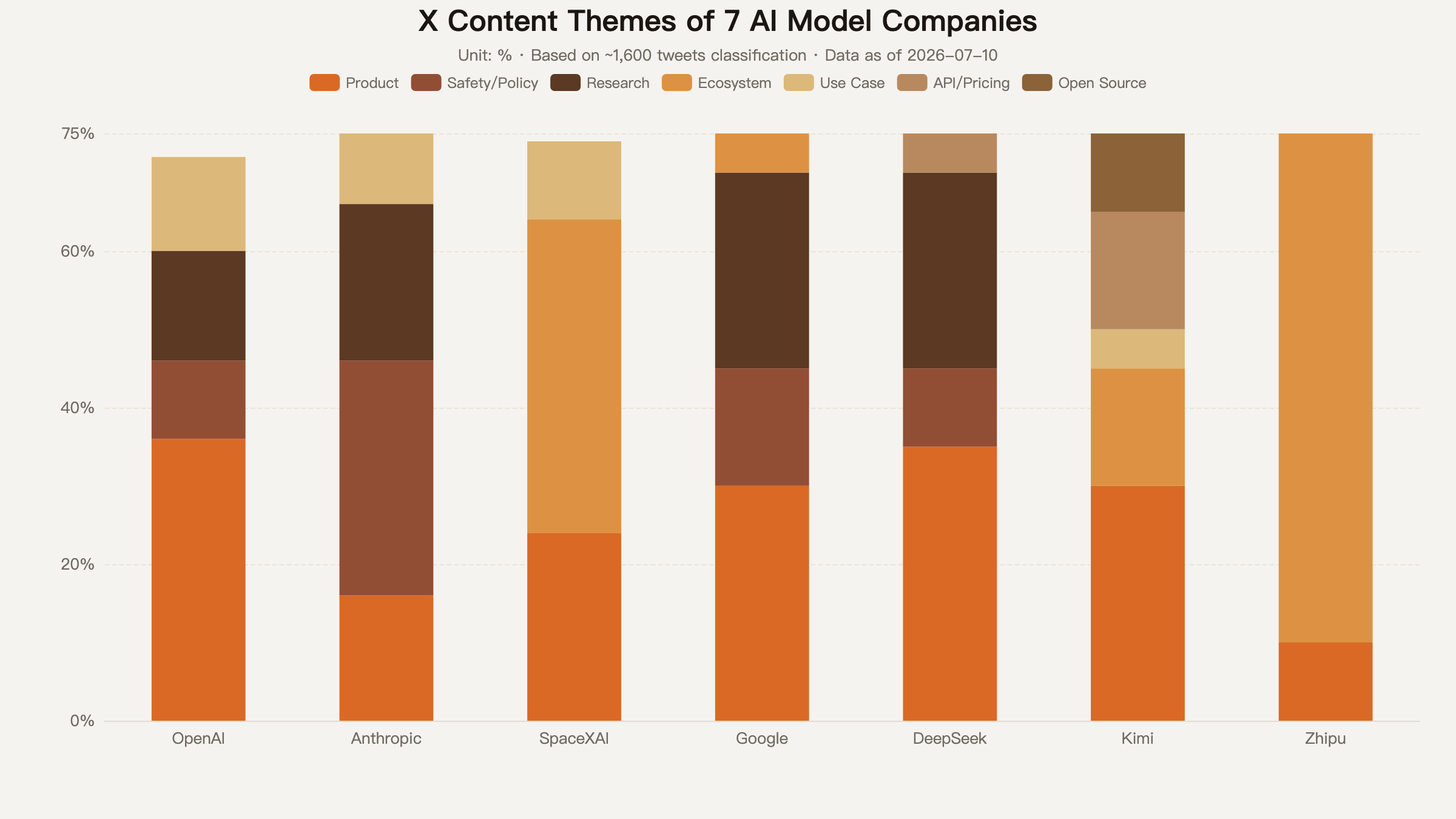
Content Throughline for Each Company
OpenAI: Saturation product barrage + agent-transition narrative. More than a third of @OpenAI's primary account is product launches, and every major release is expanded via a thread matrix. For the July GPT-5.6 launch (Sol/Terra/Luna) — three models plus ChatGPT Work plus the GPT-Live voice model — over 20 tweets went out in two days. The product narrative has shifted from "answering questions" to "doing work": ChatGPT Work is positioned as an agent "powered by Codex and GPT-5.6" that can operate across apps and files and track a project for hours.
Anthropic: Safety narrative + crisis communications. Safety/policy content accounts for 30% of @AnthropicAI — the highest share among frontier-model companies. The Fable 5 export-control incident is the recent core thread: from the June 13 suspension (92.51M views), to the June 30 lifting of controls (14.71M views), to the July 1 global restoration (15.41M views). Throughout, Anthropic maintained high transparency — every development was announced first, in language that stayed measured but informationally complete. Of CEO Dario Amodei's 22 lifetime tweets, 64% are links to long-form essays ("Machines of Loving Grace", "Policy on the AI Exponential").
SpaceXAI: Ecosystem integration as the core narrative. Between @SpaceXAI and @grok, ecosystem-integration content accounts for roughly 35–40%. Within 24 hours of Grok 4.5's release, @grok fired off 8+ "Try Grok 4.5 in X" tweets in a series, covering Cursor, Amp, AI SDK, Notion, Convex, OpenCode, Warp, and OpenClaw. The throughline is not "the strongest model" but "Grok is in every tool you use". @imagine (68K followers) has the smallest following in the matrix, yet it produced the single highest-impression tweet across all accounts (214M views) — a tweet about a lip-sync feature upgrade.
Google: Brand fragmentation + multi-account synchronized publishing. Google is the only company without a unified "Gemini" entry point. Major launches are pushed simultaneously by 3–4 accounts: for the Nano Banana 2 Lite release, @GoogleDeepMind posted the research angle, @GoogleAI the brand summary, and @GoogleAIStudio the developer-facing view ("$0.034 per 1k images", "4-second generation"). Another recent keyword is "Vibe Coding". @GoogleAIStudio runs a recurring "What are you vibe coding this weekend?" prompt every weekend, pulling 478 replies on a single tweet.
DeepSeek: Less is more. The 168 lifetime tweets have a very clear structure: model launches (R1, V3, V3.1, V4-Pro) account for 35%, open-source infrastructure (the #OpenSourceWeek five-pack: FlashMLA, DeepEP, DeepGEMM, DualPipe, 3FS) for 25%, and API pricing for 15%. No use cases, no corporate-culture content, no executive personal voice. Pure technical broadcast in a standard format (🚀 + bullet points + thread).
Kimi: Product-matrix driven. Kimi's three accounts form the most precise division of labor: @Kimi_Moonshot handles model and company-level announcements (K2.7-Code, Kimi Work, Kimi Web Bridge), @KimiProduct runs use-case video demos (WebGL shaders, 3D LEGO, a Bloomberg Terminal clone — 85% of its content is high-quality video), and @KimiDevs runs the developer community (Kimi Code CLI release logs, the plugin ecosystem). @KimiDevs only launched on June 5, 2026 — 44 tweets in 35 days, a clear push to scale up developer operations.
Zhipu: A retweet amplifier. About 70% of @Zai_org's recent 50 tweets are retweets of third-party partners announcing GLM-5.2 support — Cursor, Notion, vLLM, Ollama, Fireworks, Cerebras, Perplexity, and dozens of others. The strategy manufactures an "everyone is using GLM" share-of-voice, but the share of original in-depth content is low.
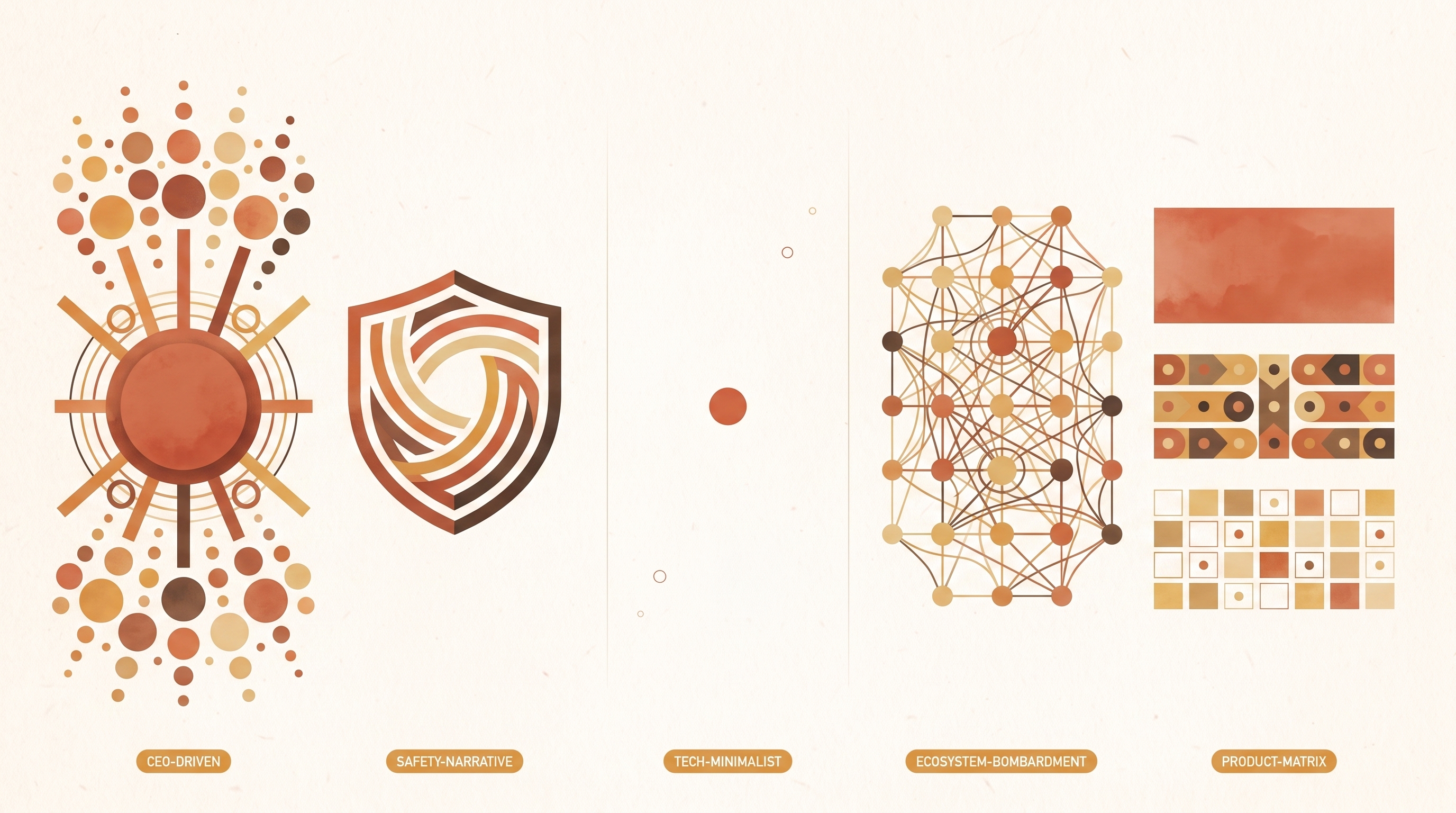
5. Several Operational Patterns
Putting the data above together, a few typical operating patterns emerge.
Pattern 1: CEO-Driven (OpenAI, SpaceXAI)
The defining trait is that the CEO's personal account vastly outranks the company account in reach. Sam Altman's and Elon Musk's personal tweets generate 5–10× or more the engagement of the official company accounts. For major launches, the company account posts the formal announcement while the CEO endorses or teases it in a personal voice — a dual track of "official + humanized".
OpenAI is more systematic here: @OpenAI (product announcements) + @ChatGPTapp (first-person-AI memes) + @OpenAIDevs (developers) + @OpenAINewsroom (corporate PR) + @sama (CEO reach) + @gdb (technical leadership) — six accounts coordinating, each with its own role.
SpaceXAI's model leans harder on Elon's individual capacity. The company account @SpaceXAI plays more of a confirm-and-follow-up role.
Pattern 2: Safety-Narrative (Anthropic)
Anthropic is the only company that anchors "AI safety" as its core brand. 30% of @AnthropicAI content is safety/policy, and CEO Dario essentially only posts long-form essays. Even commercial news like its IPO and funding rounds is immediately followed by research on economic impact and job-displacement frameworks.
The risk of this strategy is that when a real safety event occurs (the Fable 5 export controls), the company has to demonstrate transparency and communications capacity well beyond its everyday baseline. Anthropic's performance during this incident — sustained progress announcements across the 17 days from suspension to lifting — is a positive case study in crisis communications.
Pattern 3: Technical Minimalism (DeepSeek)
DeepSeek accumulated 1.05M followers with 168 tweets. No retweets of others, no replies to comments, no use cases, no corporate-culture content. Every utterance is a blockbuster release: a new model, a technical paper, an API price cut.
The precondition for this strategy is that the product itself must be inherently viral. The 12.54M views on the R1 launch tweet rest on three sentences of pure product strength — "Performance on par with OpenAI-o1, fully open-source, MIT licensed" — not on operational technique.
Pattern 4: Ecosystem Saturation (SpaceXAI/Grok, Zhipu)
The shared trait is using a large volume of third-party-partner retweets to manufacture a "Grok/GLM is everywhere" share-of-voice. SpaceXAI fired 8+ partner tweets within 24 hours of Grok 4.5's release; Zhipu retweeted 30+ Day-0 support announcements within 48 hours of GLM-5.2's release.
The difference: SpaceXAI's ecosystem integration is an actual product capability (Grok really can be used inside Cursor/Notion/Warp), whereas some of Zhipu's retweets look more like borrowing partner channels to amplify reach.
Pattern 5: Product-Matrix (Kimi, Google)
Multiple product sub-accounts each target a specific audience segment. Kimi's three-account matrix (primary + Product + Devs) has a clear structure, and Google's five-account matrix covers the full research/brand/product/developer/experiment chain.
The shared trait is using recurring formats to build user habits: Google has "shipping recap" and "vibe coding weekend"; Kimi has @KimiProduct's video demo series and @KimiDevs's release logs.
6. What Is Happening Right Now
The tweet timeline shows each company's product rhythm over the past 1–2 weeks:
Agent is everyone's keyword. OpenAI released ChatGPT Work ("powered by Codex and GPT-5.6"), SpaceXAI released Grok 4.5 ("first model trained specifically for coding and agents"), Kimi released Kimi Work (a desktop agent running 300 sub-agents in parallel), and Google pushed native Computer Use in Gemini 3.5 Flash. The product-positioning shift from "answering questions" to "doing work" shows up on X as every company densely publishing agent-related features and use cases.
Coding is the most contested battlefield. OpenAI's Codex, SpaceXAI's Grok 4.5 (co-trained with Cursor), Kimi's K2.7-Code, Zhipu's ZCode IDE, Google's Vibe Coding — nearly every company is pushing a coding-specific model or tool. Their X operations look highly convergent: benchmark scores + a wave of ecosystem partnerships + a CLI/IDE product.
Chinese companies are accelerating overseas operations. Kimi opened the @KimiDevs developer account in June — 44 tweets in 35 days, an obvious push. Zhipu's @Zai_org rebranded from Zhipu to Z.ai and now runs entirely in English. All three companies are publishing in English, benchmarking against US companies (leaderboard rankings, Day-0 ecosystem partnerships, open-source strategy) to win overseas developers. But a primary account in the 120K–180K range still sits an order of magnitude below OpenAI's 5M and DeepSeek's 1.05M.
7. A Few Observations
Follower count is not reach. @imagine has only 68K followers but pulled 214M views on a single tweet; DeepSeek has 1.05M followers but has not tweeted in 75 days. What drives reach is still whether a single piece of content has distribution value — a capability breakthrough (R1), a public event (Fable 5 export controls), a viral post (Sam's meme tweet) matters more than the accumulated output of everyday operations.
A CEO's personal IP is the biggest traffic lever. A Sam Altman tweet gets 10× the engagement of the company account; Elon gets 100× or more. All three Chinese companies are blank on this front. DeepSeek proves that product strength alone can substitute for the reach of a personal IP, but for everyday operational rhythm, the absence of a voice with distribution power is a structural shortcoming.
The choice of content themes reflects a company's strategic positioning. Anthropic's 30% safety/policy content, DeepSeek's 25% open-source-infrastructure content, SpaceXAI's 40% ecosystem-integration content — these ratios are not random choices by operations staff but the projection of company strategy onto the communications layer. What a company pushes on X tells you more about how it wants to be seen than its website does.
Closing Notes
Looking across these 1,600 tweets:
- On the day R1 launched, DeepSeek posted three sentences and pulled 12.54M views.
- Anthropic's Fable 5 export-control announcement pulled 92.51M views.
- A Sam Altman meme — "can yall please chill on generating images" — pulled 17.02M views.
Not one of these tweets could have been planned. Which is why you need a steady cadence of daily tweets, an account matrix to carry them, and a presence to maintain — without trying to deliberately engineer virality.
And as model capabilities gradually converge, the differences on X will matter less and less in "whose model is stronger" and more in "who feels like something worth following long-term": a founder who speaks, a brand with a stance, an ecosystem that keeps producing. Compared with the US model companies, the Chinese companies still have work to do.
All data in this article is as of July 10, 2026. Follower counts and engagement metrics are same-day snapshots and will continue to shift. The tweet sample is each account's 50 most recent tweets (some accounts have fewer than 50); due to X's scraping-API limitations, some accounts' tweets are sorted by engagement rather than chronologically, so frequency estimates may be skewed.