GPT-Live Launch: Full-Duplex Speech Model Arrives in ChatGPT, Delegating to GPT-5.5 in the Background
Original post: https://openai.com/index/introducing-gpt-live/ References: OpenAI official blog (2026-07-08), official statements from @OpenAI / @athyuttamre and others on X, the Help Center, and public discussion within the first 24 hours of release Information compiled: 2026-07-09
On July 8, 2026, OpenAI released its next-generation speech model, GPT-Live, taking over from Advanced Voice Mode to power ChatGPT Voice. Officially, it is described as a speech experience "closer to real conversation."
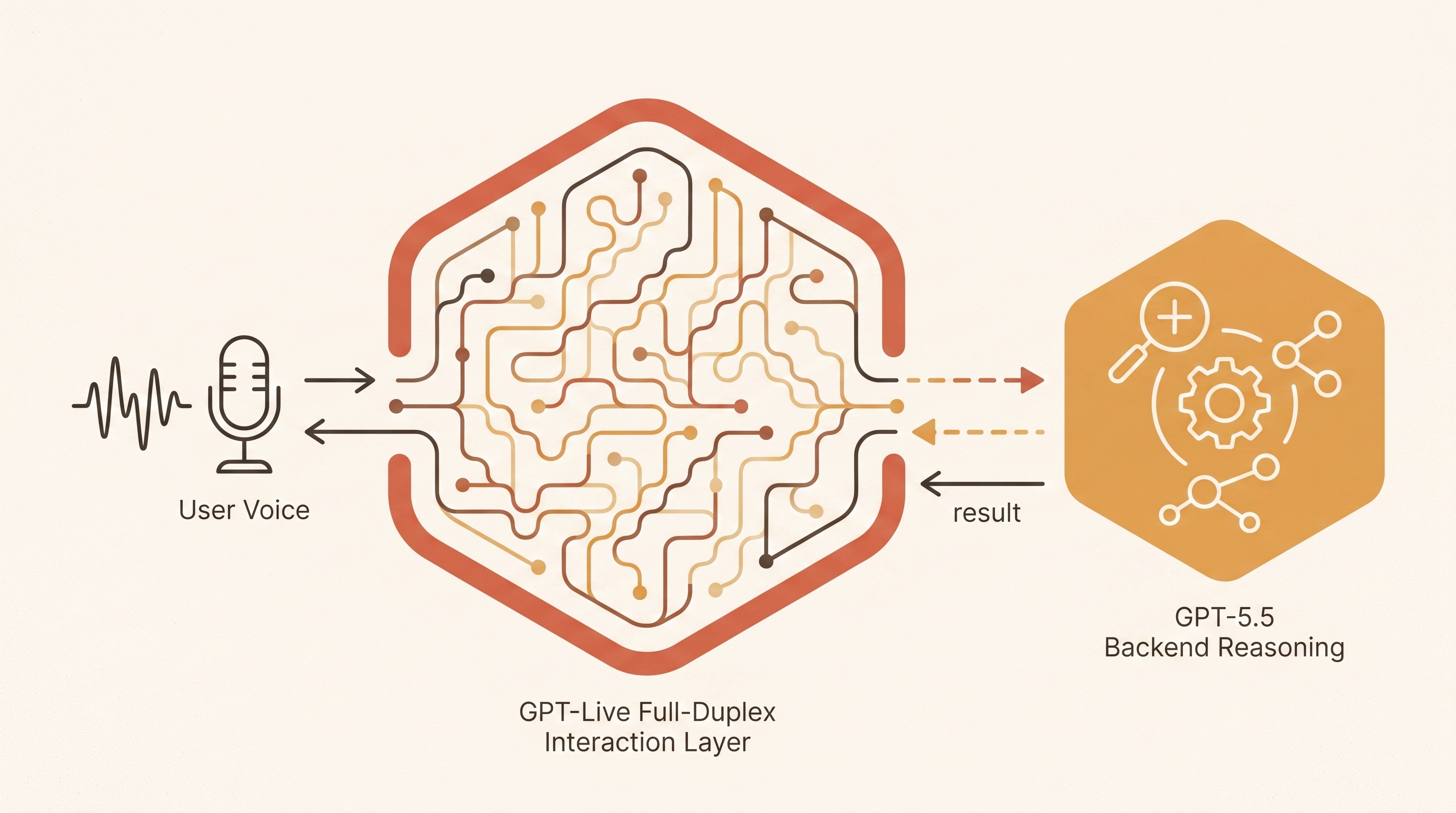
Two pillars sit at the core: first, a full-duplex architecture that can listen and speak at the same time; second, when a task needs search, deep reasoning, or more complex work, it delegates to the latest frontier model in the background (GPT-5.5 at launch) and brings the result back into the current voice conversation. This effectively separates the speech-interaction layer from the reasoning layer: when frontier models upgrade in the future, Live just swaps in a new backend — the speech-interaction layer itself does not need to change.
Two versions shipped together:
| Model | Default users | Notes |
|---|---|---|
| GPT-Live-1 | Go / Plus / Pro | Default for paid tiers; powers ChatGPT Voice |
| GPT-Live-1 mini | Free | Default for the free tier; also full-duplex |
The API is listed as Coming soon, and developers can sign up for notifications. The day after launch (July 9), @OpenAI updated: Go / Plus / Pro are fully rolled out; the free-tier rollout is underway and requires the latest ChatGPT App update.
I. Three Generations of Voice Interaction
The official framing divides the prior roadmap into two categories and explains the trade-offs of each.
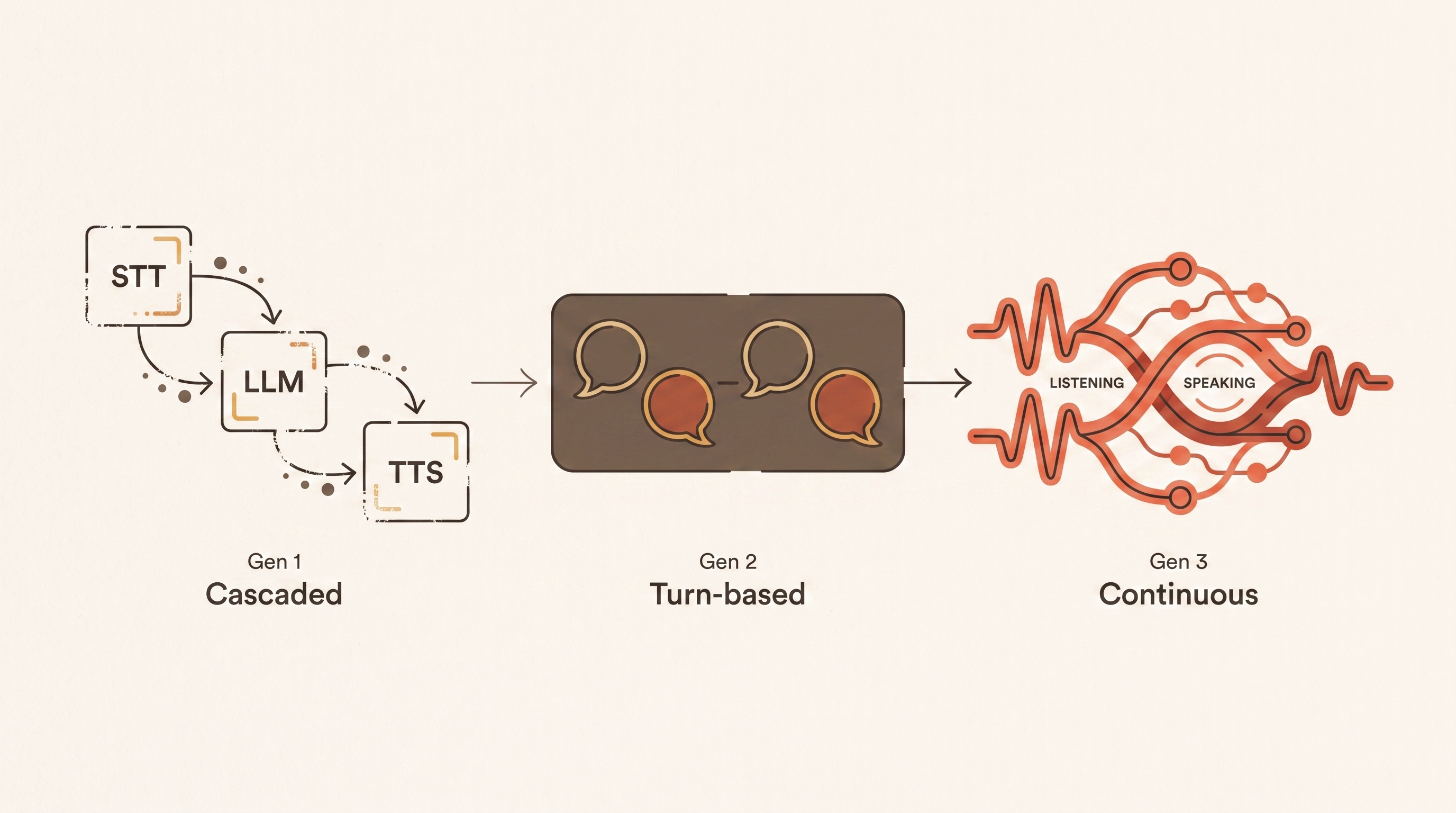
1. Cascaded Speech System
The original ChatGPT Voice chained three components together: speech-to-text (STT) → large language model → text-to-speech (TTS). It was the first time people could "talk to a frontier model," but information degrades as it passes between models, making responses slower and stiffer.
2. Turn-Based Speech Model
Advanced Voice Mode moved audio processing and generation into a single model — lower latency, smoother conversation — but it still ran in discrete turns: the model waits for the user to finish before answering. Turn boundaries typically rely on silence detection, so brief pauses or background noise are easily misread as "your turn now," causing unnatural interruptions.
3. GPT-Live: Continuous Interaction + Deep-Work Delegation
GPT-Live responds to these issues with two architectural changes:
Continuous interaction Under the full-duplex architecture, the model processes input continuously while generating output, deciding multiple times per second whether to speak, keep listening, pause, interrupt, or call a tool. Officially this enables more natural back-and-forth, better timing, and live translation.
Delegation (deep-work delegation) Everyday continuous interaction is handled by GPT-Live; when search, reasoning, or more agentic capability is needed, the task is delegated to a backend model such as GPT-5.5. Officially, Live can maintain the conversational flow while processing tasks in the background in parallel.
The community-sketched data flow looks roughly like this:
User speech ──► GPT-Live (full-duplex interaction layer)
                │
                ├─ Everyday conversation / backchannel feedback / interruption & silence decisions
                │
                └─ Complex task ──delegate──► GPT-5.5 (search / reasoning / agent)
                                              │
                                              └─ Result brought seamlessly back into the voice conversation
II. Product Capabilities
Officially, more than 150 million people use ChatGPT's Voice and dictation features per week. With GPT-Live, tapping the Voice button just works. The product capabilities listed by OpenAI include:
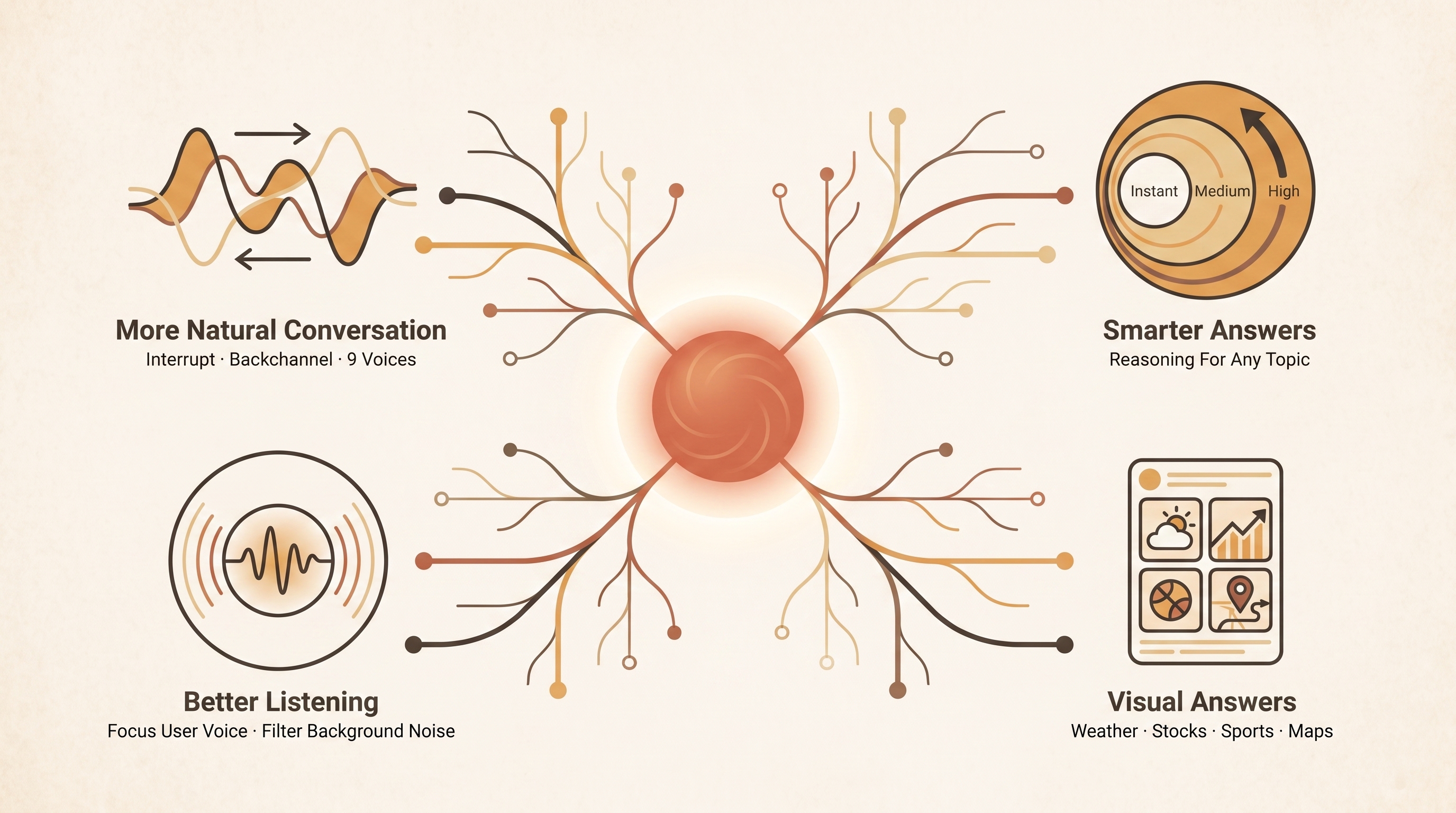
More Natural Conversation
- You can interrupt mid-sentence, pause to collect your thoughts, or ask the model to slow down
- While listening, the model gives backchannel feedback ("mhmm", "got it") to signal it is following along
- Nine voices re-recorded for GPT-Live
Smarter Answers
- The latest frontier model can be invoked in the background
- Users can choose reasoning effort: Instant (faster), Medium, High (spends more time thinking)
- Official footnote: Instant / mini map to GPT-5.5 Instant in the backend; Medium / High map to the medium / high reasoning tiers of GPT-5.5 Thinking
Better Listening
- Waits while you think instead of jumping in
- You can ask the model to stay quiet and only listen
- Stays more focused on your voice under background noise (traffic, nearby conversation, etc.)
Visual Answers
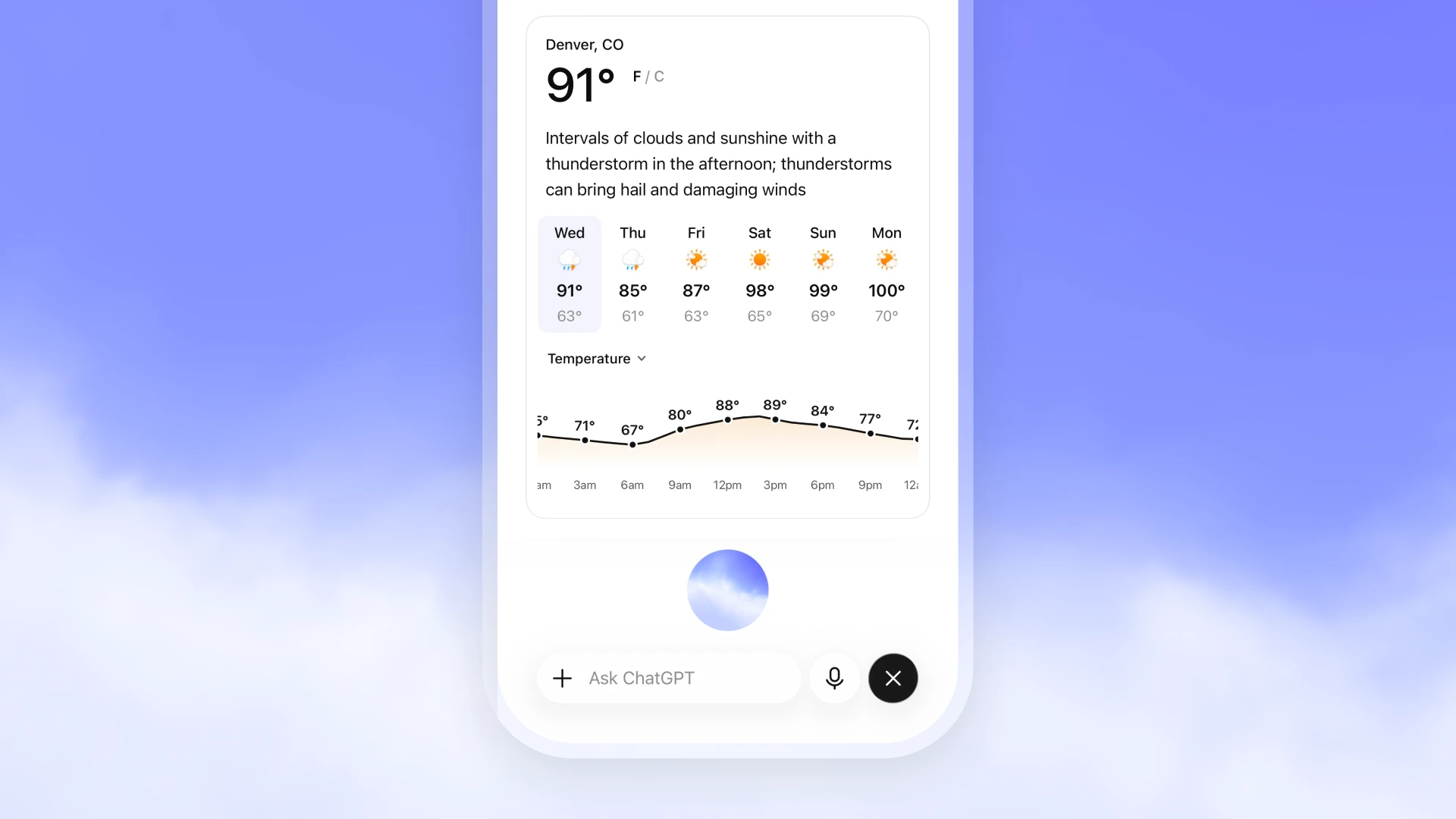
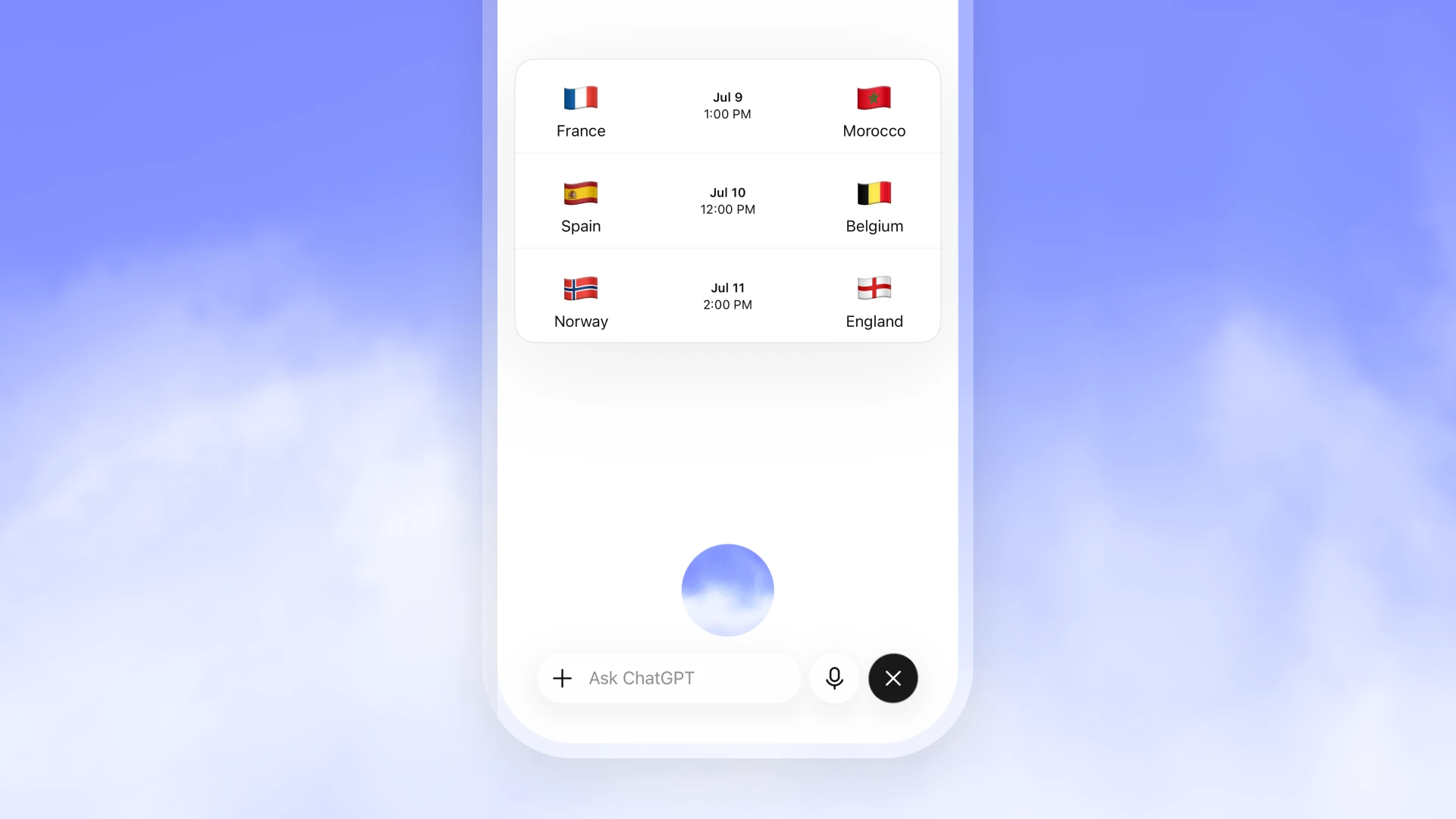
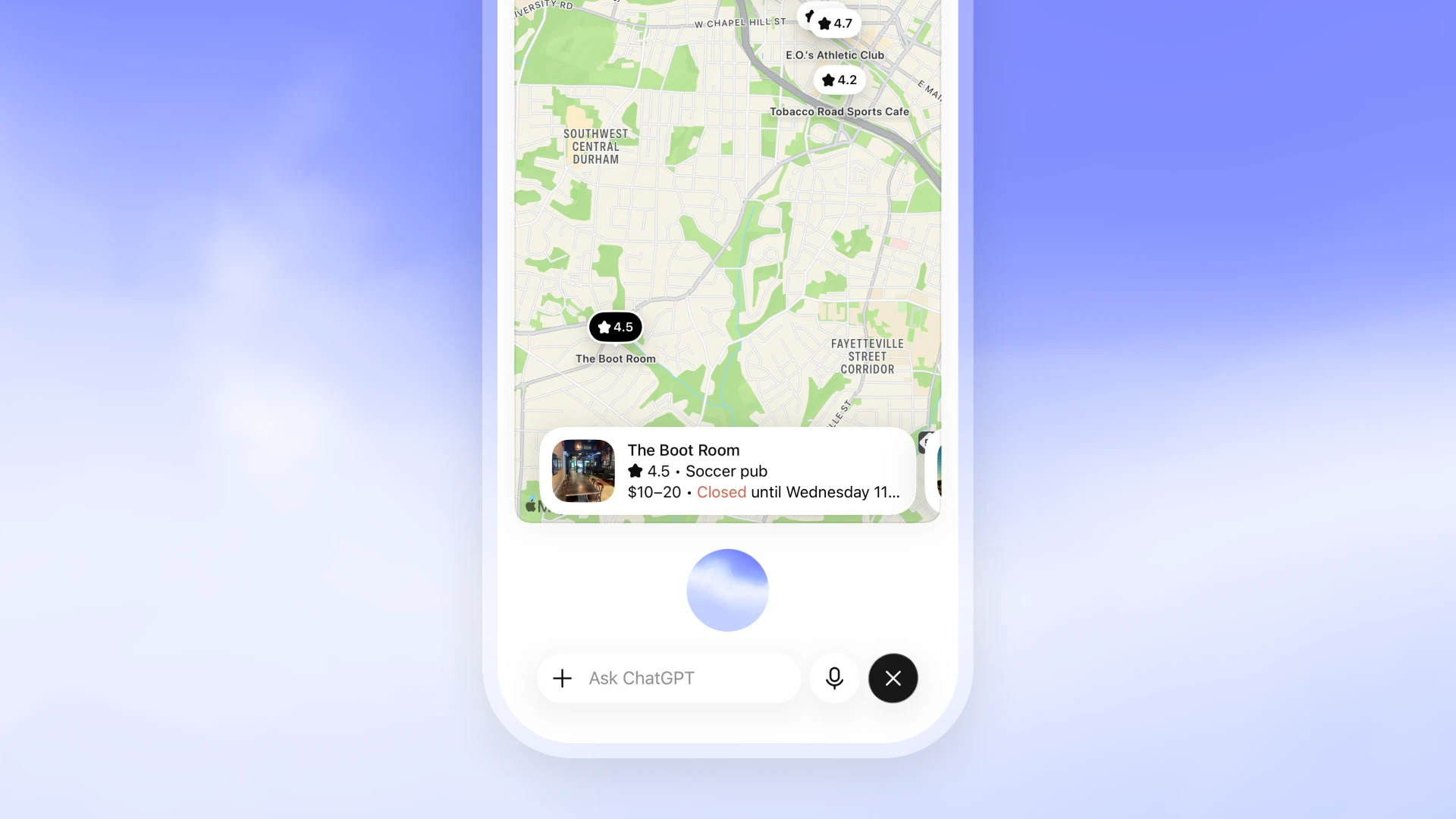
Rich media cards can pop up mid-conversation, covering weather, stocks, sports, and more; search, Memory, and image and file uploads continue to be supported.
III. Benchmark Performance
OpenAI built new human evaluations targeting pleasantness and conversational fluency: in matched 5–10 minute conversations, head-to-head comparisons were run across dimensions including overall preference, turn handoff, interruption, conversational flow, and naturalness. Both GPT-Live-1 and mini clearly outperformed Advanced Voice Mode.
On objective benchmarks, the official figures relative to Advanced Voice Mode are as follows (charts cover the Instant / Medium / High tiers; the community-circulated infographics convey these numbers consistently):
GPQA (Expert-Level Science Reasoning, Biology / Chemistry / Physics)
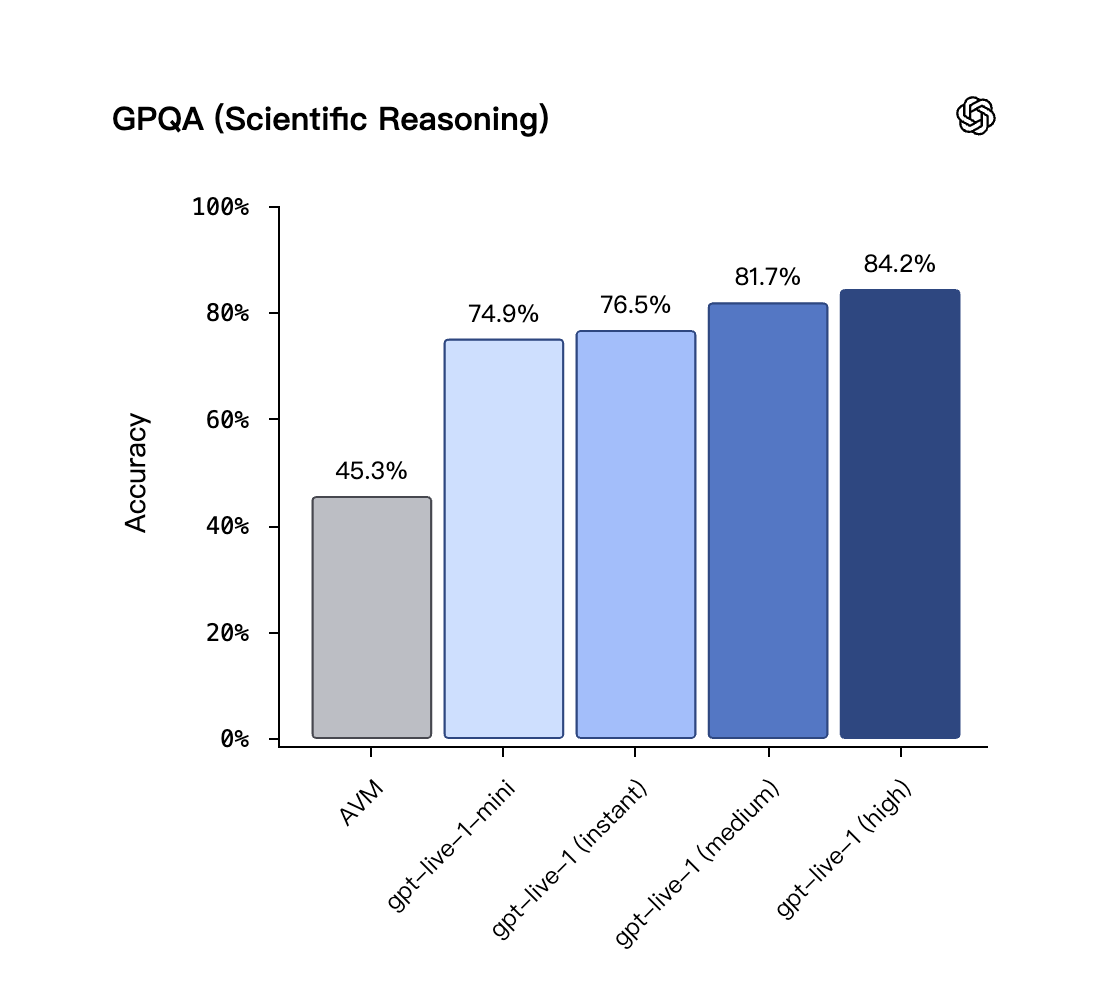
| Model / Tier | Approximate score (community transcription of official chart) |
|---|---|
| Advanced Voice Mode | 45.3% |
| GPT-Live-1 Instant | 76.5% |
| GPT-Live-1 Medium | 81.7% |
| GPT-Live-1 High | 84.2% |
BrowseComp (Agentic Web Search / Hard-to-Find Information)
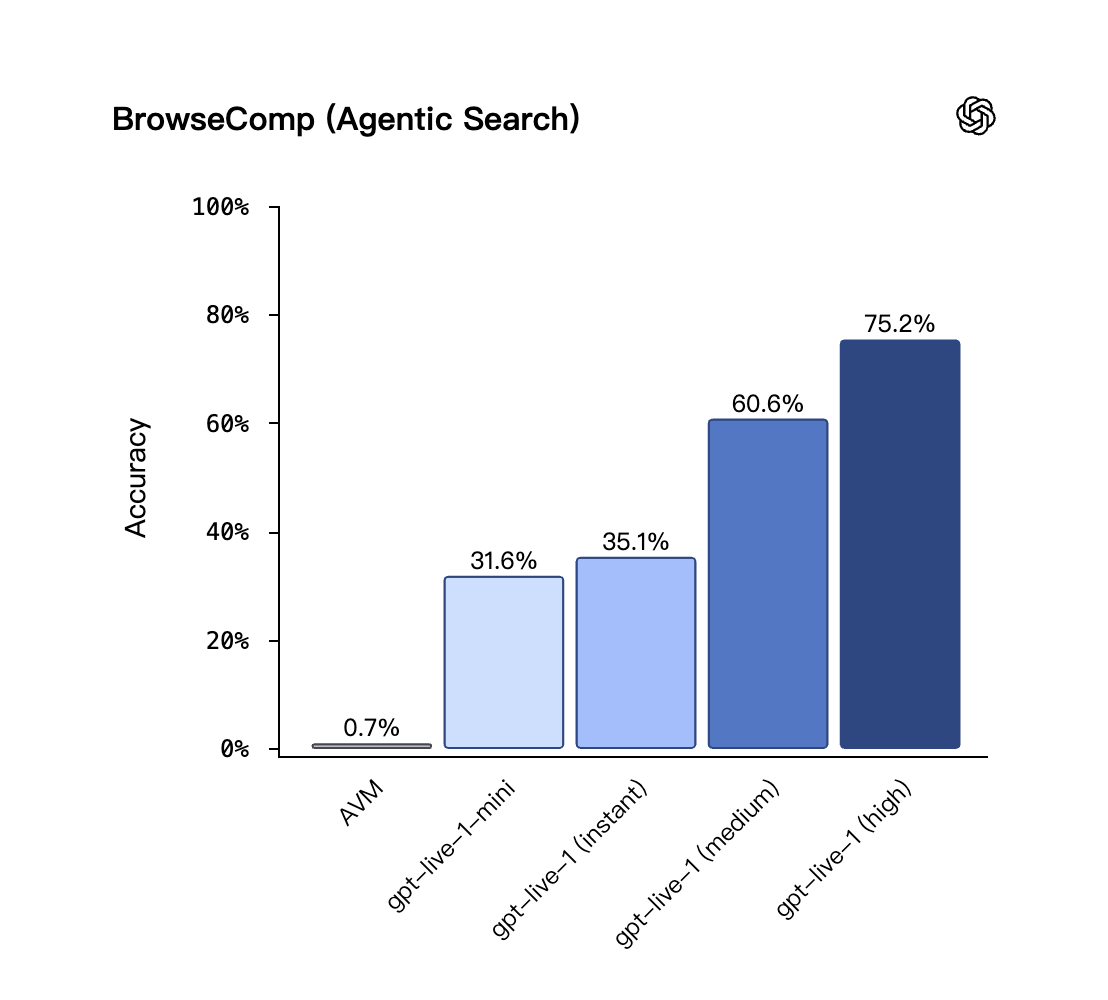
| Model / Tier | Approximate score (community transcription of official chart) |
|---|---|
| Advanced Voice Mode | 0.7% |
| GPT-Live-1 Instant | 35.1% |
| GPT-Live-1 Medium | 60.6% |
| GPT-Live-1 High | 75.2% |
BrowseComp shows the widest gap: the old Voice had essentially no agentic search capability; even the Instant tier already far exceeds Advanced Voice Mode.
The takeaway in one line: on GPQA, the Instant tier beats the old Voice by 31 percentage points, and the High tier approaches 84%; on BrowseComp, the jump from 0.7% to 75.2% is the leap from "basically can't search" to "can search." On at least these two benchmarks, the gap between the speech model and the text frontier model has clearly narrowed.
τ³-Voice Telecom (Full-Duplex Speech Agent / Multi-Turn Telecom Customer-Service Tasks)
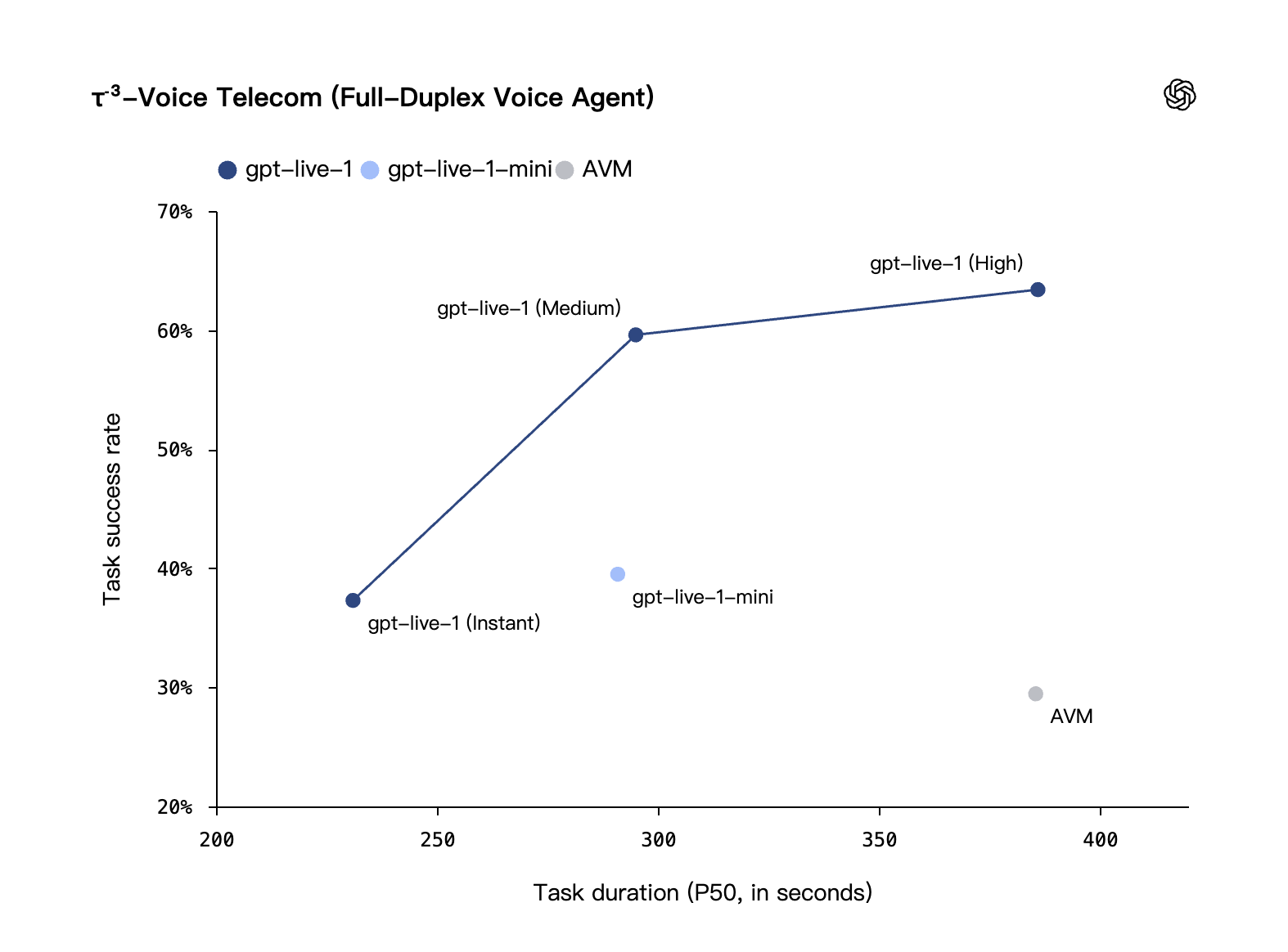
Officially, GPT-Live-1 also outperforms Advanced Voice Mode on τ³-Voice Telecom (an internal variant), which measures real, multi-turn, voice-form agent tasks.
Official footnote: In the evaluations, Instant / mini used the GPT-5.5 Instant backend; Medium / High used GPT-5.5 Thinking. The τ evaluations used a custom user model driven by the latest reasoning model.
IV. Safety Hardening
OpenAI emphasizes that GPT-Live is safe by default, layering speech-specific training and guardrails on top of the latest model-safety capabilities.
| Area | Details |
|---|---|
| Expanded evaluation | Added audio-native and synthetic-audio evaluations covering self-harm, psychosis / mania, emotional dependence on AI, violence, sexual content, and more; internal experts red team speech-specific risks |
| Real-time intervention | When a potentially unsafe output is detected, it can pivot to a safer response mid-speech, surface safety information / resources, or — in higher-risk scenarios — end the voice session |
| Self-harm support | Adapts ChatGPT's existing support flow to voice, including expert-reviewed crisis hotline resources |
| Teens | Age-appropriate behavior is built into the model; parents can decide via Parental Controls whether teens may use Voice; higher-risk self-harm-indicator scenarios can notify linked parents |
| Long-term monitoring | Post-launch monitoring and measurement for emotional dependence, continuing prior research on emotional use and mental well-being |
| Voice boundary | Only ChatGPT's preset voices are used; guardrails prevent imitation of real people's voices |
Officially, across the safety dimensions evaluated, GPT-Live performs at least on par with — or better than — Advanced Voice Mode. See the official blog post and System Card for details.
V. Availability and Known Limitations
Availability (~24 hours after launch)
| Item | Status |
|---|---|
| Platform | ChatGPT iOS / Android / Web |
| Go / Plus / Pro | GPT-Live fully rolled out (2026-07-09 official statement) |
| Free | Rollout underway; defaults to GPT-Live-1 mini |
| Entry point | Voice button; Settings → Voice → Model shows Live |
| Client | Requires the latest ChatGPT App update |
| API | Not yet available (Coming soon) |
| Languages | Optimized for select popular languages; some languages may have accent or fluency gaps. Multilingual support and accents are officially a priority improvement area |
Day-One Feature Gaps (Help Center / community summary)
Features that GPT-Live does not yet support at launch — or that require falling back to the legacy Voice path — include:
- Video calls
- Screen sharing
- connected apps / plugins
- Temporary Chats
- desktop app
- Work
- Codex
- custom GPTs
Officially, at launch ChatGPT does not support voice + video / screen sharing — those capabilities are still being built. When needed, users can still use the legacy path via Standard / Advanced Voice Mode, where these capabilities remain available.
Known Product Issues
The head of ChatGPT Voice, @athyuttamre, has publicly acknowledged that Memory under GPT-Live is not reliable enough and that the team is investigating. Another frequent complaint is that interruptions and backchannel feedback are too frequent: in the official demo and day-one user feedback, "interrupts too much" and "mhmm/uh-huh too dense" came up repeatedly; the official suggestion is to simply tell the model to "stay quiet."
There are also Reddit reports of Plus users hitting the daily limit after about an hour on Live-1 and being auto-switched to mini, as well as reports of a tier-switching loop bug.
Additionally, GPT-Live and the existing Realtime API product line on the API side are two different things: GPT-Live is the next-generation model on the ChatGPT Voice product side, and its "coming to the API" is not the same thing as the Realtime API — don't confuse them.
VI. Community Feedback
We rounded up some public discussion from X / Hacker News (HN) / Reddit within the first 24 hours.
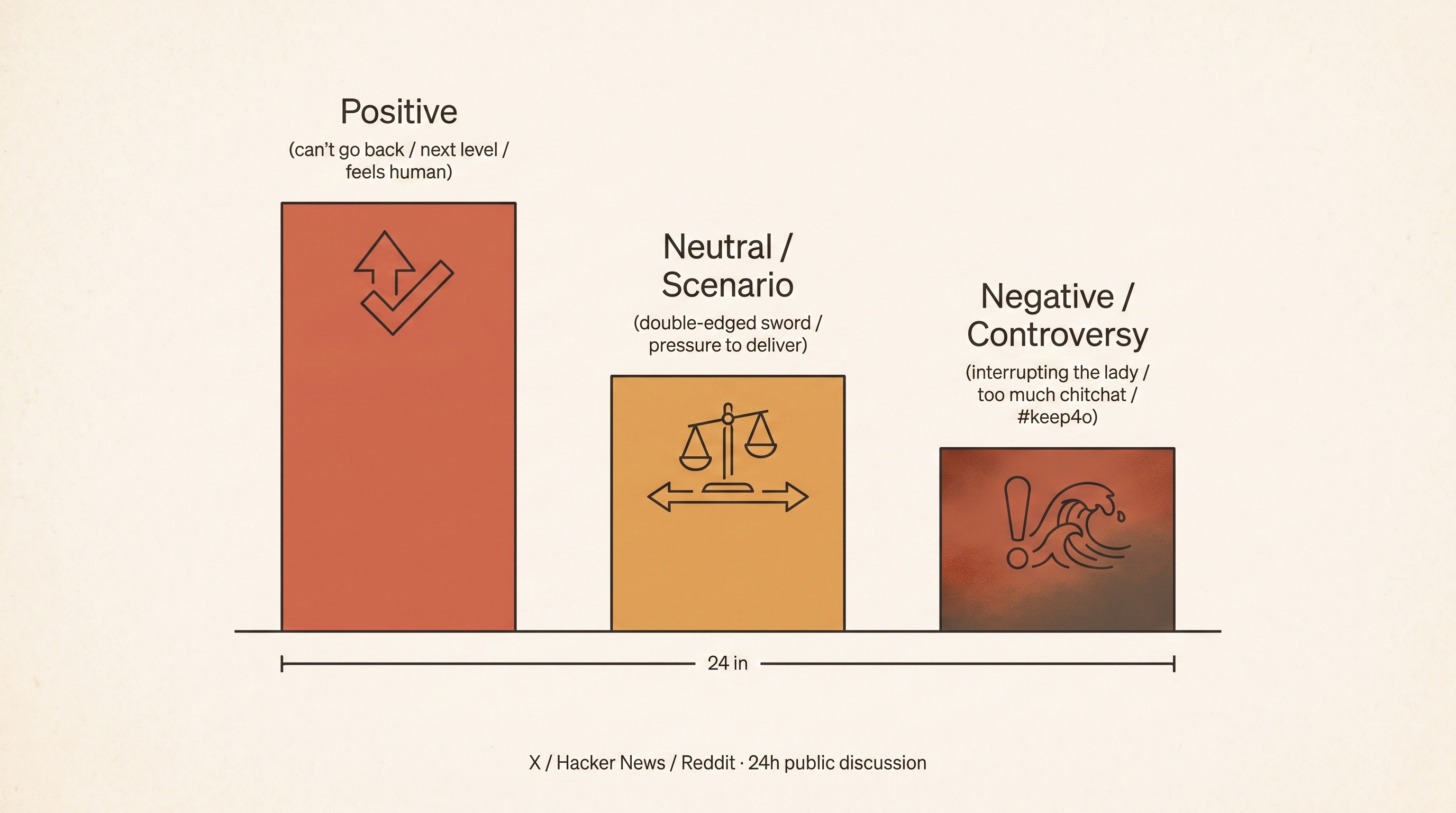
Positive Feedback
- @fdaudens: After a few weeks of internal testing, voice is on by default — "can't go back"; GPT-Live with interactive widgets is next level
- @romainhuet (OpenAI DX): Emphasized "smartest" and "extremely natural" — specifically the ability to listen and speak at once, live translation, and chatting while looking at images
- @wanerfu (Chinese hands-on): "The conversation finally feels human"; more natural tone, interrupts naturally, has emotional feedback
- @Rabbuttz_VR (Japanese): The uncanny feeling is almost gone; attached a long video demo
- @2okutameo (Japanese): Compared to Alexa, "the performance gap is night and day"
- @masahirochaen: A live English→French simultaneous interpretation scenario in a Parisian antique bookstore; judged that consumer-facing translation startups could be hit hard
- @ArtemisArgento (investment-research lens): Voice has roughly 150 million weekly active users, about 15% penetration; voice ≈ 5× text compute, video ≈ 10× voice; latency path: Siri 1–3s → old Voice ~500ms → Live ~300ms
Neutral / Scenario-Based Feedback
- @ArtemR: The cleanest "double-edged sword" line: "In theory I love the faster full-duplex response, but GPT-Live keeps interrupting with useless chatter and filler words — it's so annoying. The future is closer, but it definitely needs tuning."
- @digg: After 500k views, reactions were mostly positive; the pressure is whether voice can stop feeling like a demo
- @sitinme (HN/Reddit roundup): What people liked — it finally doesn't feel like a walkie-talkie, the backend taps GPT-5.5, great for brainstorming on walks/drives/commutes; background-noise handling is better but still not perfect
- @xiaohu (Chinese): Not just full-duplex — it can also call GPT-5.5 and generate real-time UI cards; the "personal AI assistant" narrative puts Siri / the Apple ecosystem under threat
- @nanhaier (Chinese): Yesterday OpenAI shipped GPT-Live and xAI shipped Grok 4.5 — "one bets on human–computer interaction, the other bets on coding capability. The AI race has entered daily-update mode."
Negative Feedback and Controversy
- The official demo interrupting an older woman became an instant meme: @AutismCapital "keeps interrupting her lmao"; @brian_lovin "the computer keeps interrupting the person"; @robfromeighty1 "a voice model that interrupts the user and talks over them? No thanks."
- @WilliamVWrites: Wants a slider to dial down the uh-huh frequency — "when people talk over you like that it's already annoying enough; a robot doing it? Maddening."
- @DJSanghera: Interruption needs visual input to judge; without it, it's always a bit off.
- @Ozakinico (Japanese): An uncanny-valley specimen — "too real, kind of creepy/gross."
- @ConnorCuriousUS: Still face-plants on basic little tests — "two E's in seventeen" and an awkward "natural sign-off" both went wrong.
- @dotey (Chinese long thread, ~21k views): Core takeaway in three points — third-generation voice (walkie-talkie → full-duplex), the split between the speech-interaction layer and the reasoning layer, and day-one's "the backchannels designed to sound natural ended up being annoying" plus the feature gaps; gem of a comment in the thread: "evolving from a walkie-talkie into a motormouth sidekick who won't stop interrupting — the first hurdle is learning not to talk over people."
- #keep4o sentiment: The main thread keeps surfacing #keep4o / #BringBack4o hashtags — this is users' long-running protest against the old model being deprecated. It is a separate matter from Live's full-duplex technology itself and should be treated as such.
One high-frequency topic: comparing GPT-Live with Doubao Voice (豆包语音). Most people grant that GPT-Live's English performance, intelligence, and simultaneous interpretation are widely affirmed; but in Chinese contexts the smoothness and companionship tuning do not seem to have the edge, and its video capability was also flagged as somewhat behind.
VII. Onboarding and Usage
- Update iOS / Android ChatGPT to the latest version, or use the Web
- Open Voice; under Settings → Voice → Model, confirm Live / Live mini
- Paid users should default to GPT-Live-1; if you are still on the old mode, check your App version or wait for the rollout
- If it interrupts too much, give a verbal instruction: "stay quiet / let me finish first"
- When you need video, screen sharing, plugins, Codex, etc., temporarily use the legacy Voice path (if the product still offers it)
- Developers: wait for the GPT-Live API to open; do not conflate it with the existing Realtime API
VIII. Roadmap
Follow-up plans disclosed by the official channels and community:
- API: Not yet available (Coming soon); developers can sign up for notifications. It is not the same thing as the existing Realtime API product line on the API side
- Multilingual support and accents: Officially a top priority; select popular languages are already optimized, the rest have accent or fluency gaps
- Video and screen sharing: Still being built; at launch ChatGPT does not support voice + video / screen sharing; the legacy Voice path temporarily retains these capabilities
- Memory: The head of ChatGPT Voice, @athyuttamre, has publicly acknowledged that Memory under GPT-Live is not reliable enough and is being investigated
- Interruption / filler tuning: Day-one's "interrupts too much" and "uh-huh too dense" are high-frequency feedback; the community is calling for a slider to control backchannel frequency
References
- Official blog: https://openai.com/index/introducing-gpt-live/
- Official launch post: https://x.com/OpenAI/status/2074907025537224840
- Paid-tier full-rollout update: https://x.com/OpenAI/status/2075019750569378007
- Memory issue statement (@athyuttamre): https://x.com/athyuttamre/status/2075052389980401829
- @dotey Chinese long thread: https://x.com/dotey/status/2075085137990005164
- @fdaudens default-voice post: https://x.com/fdaudens/status/2075011510045233457
- @ArtemR double-edged-sword feedback: https://x.com/ArtemR/status/2074951440968106152
- @wanerfu Chinese hands-on: https://x.com/wanerfu/status/2075079276865659128