
7 Data Sources, 62 Frameworks: What Programming Language Popularity Really Has to Do With LLMs
TypeScript has the most contributors on GitHub, but ranks only 47th on TIOBE. Same language, same moment in time, yet a 46-place gap across two rankings. That isn't because one ranking is wrong — it's because the two are not measuring the same thing.
To understand "how AI is actually reshaping the programming language landscape," a single ranking isn't enough. We place six language-popularity rankings alongside OpenRouter's AI-generated code distribution and the GitHub update speed of 62 mainstream frameworks, aiming to answer three questions: what is the relationship between language popularity and LLMs; whether the language distribution of AI-generated code matches developers' actual usage; and whether a language's popularity correlates with its frameworks' iteration speed. Data was collected on 2026-07-12, covering 7 data sources, 13 languages, and 62 frameworks.

First, the methodology: 7 rankings measure 7 different things
These seven rankings all appear to track "popularity," but they measure fundamentally different things.
| Ranking | What it measures | Leans toward |
|---|---|---|
| GitHub Octoverse | People actually writing code (contributor count) | Closest to "who's using it" |
| Stack Overflow Survey | Self-reported developer usage | Practitioner preference |
| OpenRouter | Language distribution of AI-generated code | AI-coding context |
| TIOBE | Count of "X programming" search results | Attention / discussion |
| PYPL | Frequency of "X tutorial" searches | Learning intent |
| Google Trends | General search trend | Broad public attention |
| Framework commits/day | Ecosystem iteration speed | Project activity |
So "programming language popularity" must be broken into at least four distinct dimensions: who's using it, who's learning it, who's searching for it, and what AI is generating.
Python's lead is amplified in the AI-coding context
Python doesn't command a dominant lead on every ranking, but in AI-coding scenarios its advantage is clearly amplified.
OpenRouter's data is the most direct. It tallies the tokens consumed when developers call various LLMs through OpenRouter to generate code in different languages. Python's token usage is roughly 1.7T — 2.25× the runner-up JavaScript (~754B) and 9.4× third-place TypeScript (~180B). On the "AI writes code" axis, Python's lead far outstrips every other language.
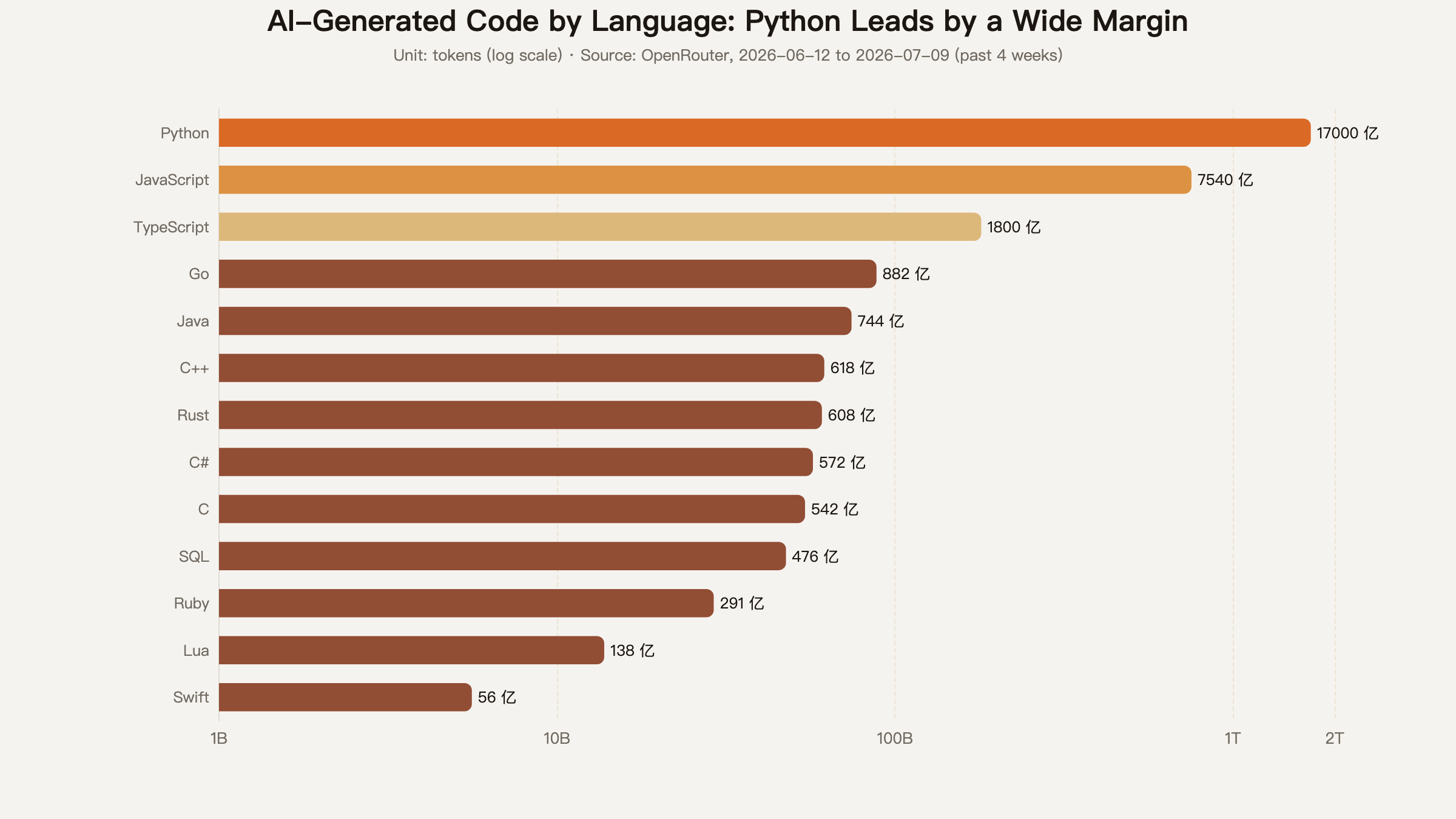
GitHub Octoverse 2025 shows that in August 2025 TypeScript overtook Python and JavaScript for the first time to become the language with the most monthly contributors on GitHub — the most significant ranking shift in programming languages over the past decade. On the "who's writing code" axis, Python ranks second; it does not command a dominant lead there.
On learning intent, the picture differs again. PYPL tracks the frequency of "X tutorial" searches on Google, where Python holds about 47.5% share — more than 4× the runner-up Java (~11.4%). In Google Trends' weekly data over the past 12 months, Python climbed gradually from 18–23 in the second half of 2025 to 30–34 in May–June 2026, the fastest growth rate among mainstream languages.
Aggregating these dimensions, Python's lead from strongest to weakest is: AI-generated code, actual developer usage, search popularity. The lead on the AI axis is by far the most pronounced.
There's also an apparently contradictory signal. On TIOBE, Python posted a year-over-year decline of 8.03% — the largest drop of any language on the list — while over the same period PYPL rose 16.5% and Google Trends is also climbing. Why would "tutorial" searches be rising while "programming" searches fall? One possible explanation: when developers hit programming problems, they're shifting from Googling "Python programming how to..." to asking AI tools directly. If that holds, TIOBE's decline may not reflect Python cooling off, but rather that how developers obtain programming information is changing. There's no direct data proving that the search decline is entirely caused by AI-tool substitution; it can only be treated as one explanation consistent with observed trends.
AI-generated code vs actual developer use: broadly aligned, two clear discrepancies
OpenRouter's language distribution broadly aligns with GitHub's overall ranking, but Python and TypeScript show divergences in opposite directions. A caveat first: OpenRouter counts token usage, GitHub counts contributor headcount — the two use different measurement bases. So ranking differences only indicate that the language mix of AI-generated code and actual developer use aren't fully in sync; they can't be used to infer that AI has already changed developers' language choices.
Placing the two rankings side by side:
| Language | OpenRouter token rank | GitHub contributor rank | Discrepancy |
|---|---|---|---|
| Python | #1 (~1.7T) | #2 | Higher on the AI axis |
| JavaScript | #2 (~754B) | #3 | Broadly aligned |
| TypeScript | #3 (~180B) | #1 | Lower on the AI axis |
| Go | #4 (~88.2B) | #5 | Broadly aligned |
| Java | #5 (~74.4B) | #4 | Broadly aligned |
| C++ | #6 (~61.8B) | #6 | Aligned |
| Rust | #7 (~60.8B) | ~#8 | Broadly aligned |
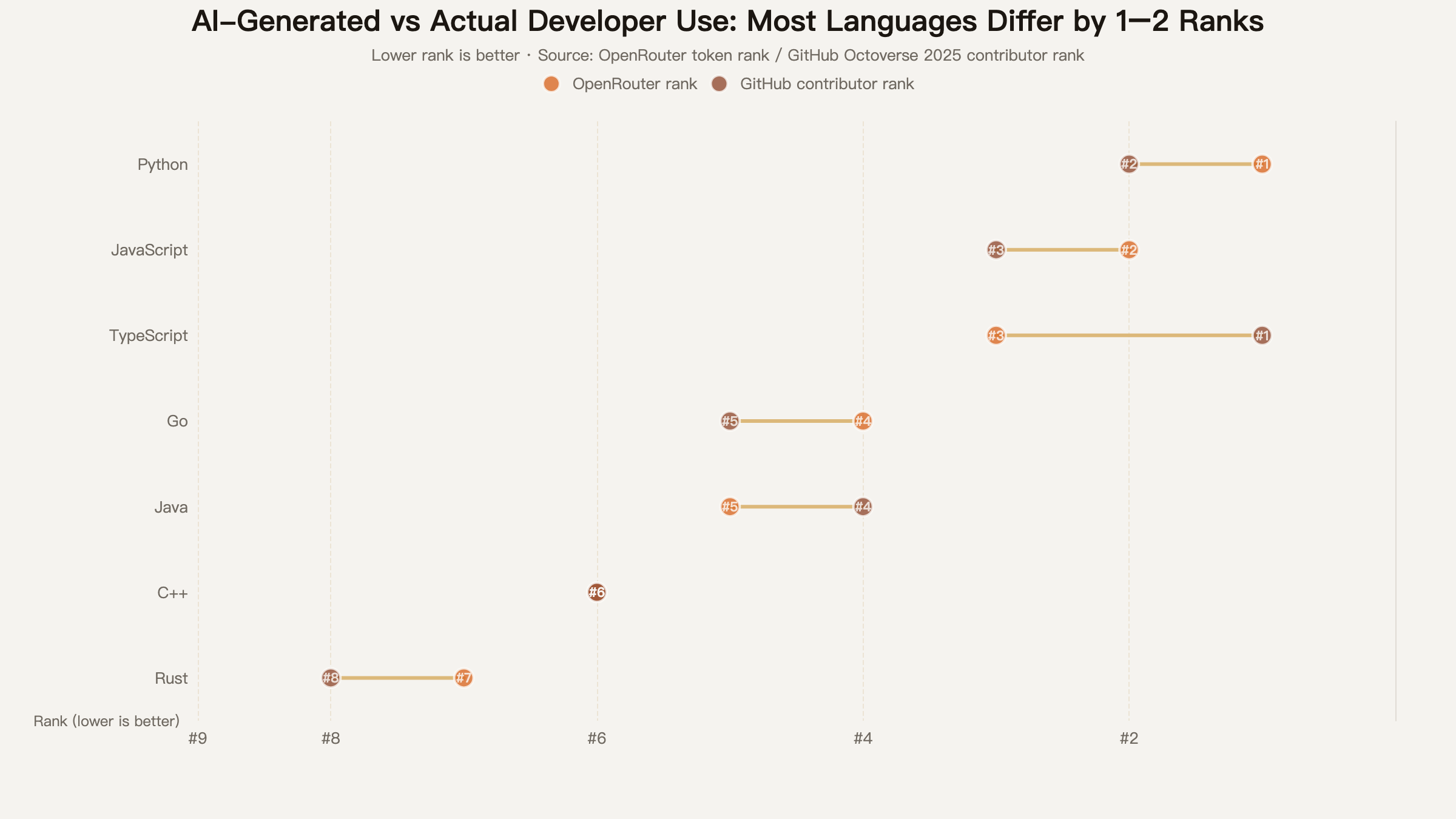
Most languages differ by only one or two places across the two rankings, with no obvious systematic bias. The differences concentrate on Python and TypeScript, and they run in opposite directions.
Python's discrepancy: #1 on the AI axis, #2 on GitHub. In AI-generated-code token volume, Python is far ahead. This is likely tied to AI and data development's heavy dependence on Python — commonly used frameworks like PyTorch, LangChain, and Pandas all concentrate in the Python ecosystem. The net result: Python's lead in AI scenarios is larger than its lead in general-purpose development.
TypeScript's discrepancy: #3 on the AI axis (180B), #1 on GitHub. TypeScript is the language with the most contributors on GitHub, yet its AI-generated-code token volume is only 1/9.4 of Python's. There's no direct data yet to explain this gap. One possibility: many TypeScript projects still rely on the JavaScript ecosystem, and some AI-generated JavaScript code ultimately ends up used in TypeScript projects. OpenRouter counts "tokens labeled as a given language," and the boundary between JavaScript and TypeScript is blurrier in AI-generation contexts than in actual developer use. A snippet of JavaScript plus type annotations can become TypeScript, and vice versa. Verifying this explanation would require finer-grained labeling data.
TypeScript is also an extreme sample for observing how ranking methods differ. It ranks #1 on GitHub, #3 on OpenRouter, yet only #47 on TIOBE — a 46-place spread between highest and lowest. TIOBE uses search terms like "X programming," but when developers search for TypeScript they tend to add context like "React" or "frontend" and rarely search "TypeScript programming" directly. TIOBE's methodology therefore struggles to fully capture TypeScript's actual popularity.
Another signal in OpenRouter's data: Chinese models command a high share
OpenRouter's data also reveals a phenomenon unrelated to language popularity but worth noting: in AI code-generation scenarios, Chinese models command a high share, with a somewhat counterintuitive characteristic.
Combining the share of Chinese vendors (Tencent Hy3, Xiaomi MiMo, DeepSeek, GLM 5.2, MiniMax) within each language's Top 5 models:
| Language | Combined Top-5 share of Chinese models |
|---|---|
| Swift | 71.0% |
| C# | 65.5% |
| Java | 62.3% |
| Rust | 61.6% |
| Go | 61.0% |
| SQL | 60.4% |
| C | 59.3% |
| TypeScript | 56.7% |
| Python | 54.5% |
| JavaScript | 38.3% |
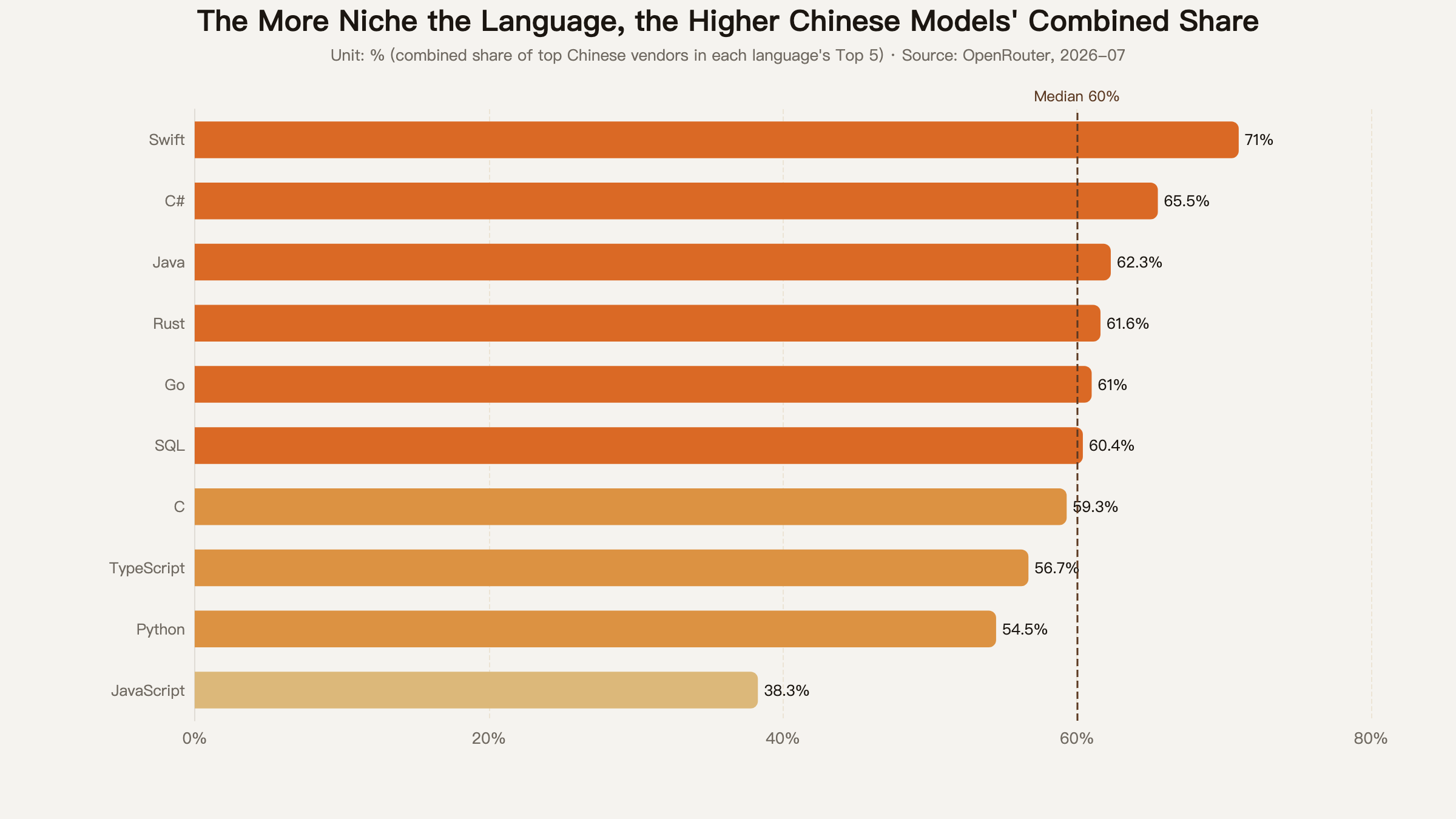
Across this sample, the more niche the programming language, the higher Chinese models' share tends to be. Swift (71%), C# (65.5%) and the like show the highest combined share for Chinese models. JavaScript is a clear outlier: GPT-5.5 and Gemini 2.5 Flash are more competitive on JavaScript, compressing Chinese models' combined share to 38.3%. One possible explanation is that models from OpenAI, Google, and similar companies carry stronger brand equity on mainstream languages like JavaScript and Python, and users are more inclined to choose them for these high-frequency scenarios. On relatively niche languages, users may lean toward free or low-priced models. Tencent Hy3 is free on OpenRouter, which also inflates its share.
A data-basis caveat is warranted here: these figures come only from the OpenRouter platform, and Hy3 being free also skews Chinese models' share upward, so this can't be taken as representative of the model distribution across the AI-programming industry. Still, Chinese models are clearly competitive in code-generation scenarios. Even on Python — the most hotly contested language — the combined share of five Chinese vendors reaches 54.5%.
Framework update speed and language popularity aren't the same thing
The last question: if a language is popular, does that mean its ecosystem is equally active?
The answer is: not necessarily. After comparing the update speed of 62 frameworks, the more pronounced dividing factor isn't language popularity, but whether the project has a full-time enterprise team behind it.
Group the 62 frameworks by language and compute the median commits/day. Here, commits/day refers to the daily average frequency of the most recent 20 commits; 20.0 is the ceiling of the collection method, indicating 20 or more commits completed within a single day.
| Language | Median framework commits/day | Corresponding popularity rank (GitHub) |
|---|---|---|
| TypeScript | 20.0 | #1 |
| C++ | 20.0 | #6 |
| Java | 10.0 | #4 |
| SQL | 10.0 | — |
| Go | 8.34 | #5 |
| C# | 8.34 | Second tier |
| JavaScript | 6.67 | #3 |
| Python | 5.84 | #2 |
| PHP | 4.05 | — |
| Rust | 2.33 | ~#8 |
| Kotlin | 1.25 | — |
| Swift | 0.33 | ~#15 |
| Ruby | 0.11 | Second tier |
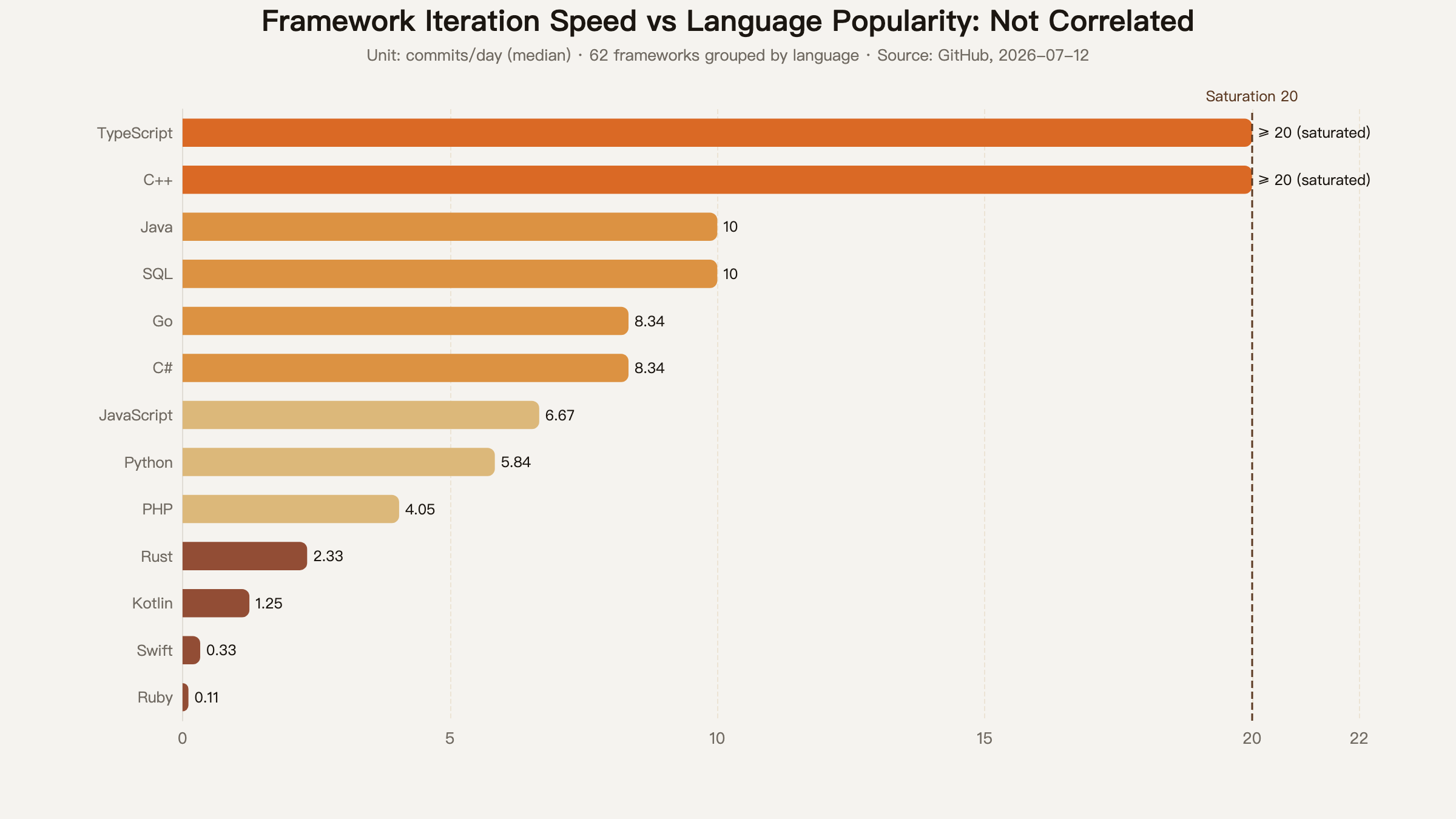
Several divergences worth unpacking:
TypeScript ranks #1 in popularity and also has the fastest framework iteration speed (median 20.0/day) — the two metrics are largely in sync. Bun, Deno, and NestJS are all in the saturation zone (commits/day ≥ 20, i.e., 20 or more commits in a single day), yet the TypeScript compiler itself sits at only 0.25/day. This also shows that a programming language's own iteration cadence and the activity of its framework ecosystem are two different metrics.
C++'s popularity rank sits between #3 and #6, yet its framework iteration speed is tied for first. LLVM, ClickHouse, and TensorFlow are all in the saturation zone, backed by full-time enterprise teams. C++ also appears in the Top 5 languages of 80% of new repositories. Its popularity rank is below Python's, but in scenarios with a hard requirement for system-level performance, C++ remains widely used, and the iteration frequency of relevant core infrastructure projects is far higher than most language frameworks.
Python clearly leads on the AI and learning axes, but its framework commit-frequency median ranks only eighth. AI frameworks update very frequently — PyTorch at 20/day, Pandas at 20/day, LangChain at 6.67/day — but Django is only 5/day and Flask as low as 0.24/day, dragging down the overall median. The Python ecosystem contains both rapidly iterating AI frameworks and classic web frameworks that have entered low-frequency maintenance, so the median isn't standout.
Rust ranks #1 in satisfaction and climbed 8 places on TIOBE, but its framework iteration speed ranks only tenth. ripgrep and Clippy are in the saturation zone (20/day), but Actix is only 1.0/day and Axum only 0.41/day. Rust's toolchain is still evolving rapidly, while application-framework activity is comparatively low — the ecosystem hasn't yet reached a stable phase.
Ruby and Swift have the lowest framework commit frequencies. In the Ruby ecosystem, Rails is at 10/day and Homebrew at 20/day, but Jekyll is only 0.11/day and Sinatra and Vagrant both 0.1/day, indicating that many classic projects have entered maintenance mode. Swift is even more pronounced: Alamofire at 0.08/day, Vapor at 0.16/day — the iteration speed of both cross-platform and server-side ecosystems is fairly slow.
The commit frequency of enterprise-backed projects is almost unaffected by language popularity. Infrastructure projects like Kubernetes (Go), LLVM (C++), ClickHouse (C++), .NET Runtime (C#), DuckDB (SQL), and TensorFlow (C++/Python) sit in saturated iteration regardless of language. By contrast, some mature community-driven frameworks have entered low-frequency maintenance — Express at 0.22/day, Flask at 0.24/day, Jekyll at 0.11/day.
This dataset also has clear limitations. Commits/day is just a snapshot, susceptible to project release cycles — commits cluster before a release and thin out after. Still, a cross-sectional comparison across 62 frameworks makes the "enterprise-backed vs community-driven" divide visible.
Closing thoughts
Synthesizing the comparison across 7 data sources and 62 frameworks, a few observations are relatively clear:
- AI-generated code further amplifies Python's lead, but on the axis of actual developer participation, TypeScript ranks #1.
- OpenRouter's language distribution broadly aligns with GitHub's ranking, but the discrepancies in Python and TypeScript reflect the specifics of AI-coding scenarios: Python's lead is larger on the AI axis, while TypeScript's relative rank is lower on the AI axis.
- Compared to language popularity, framework iteration speed is more strongly shaped by how a project is driven.
- Python's decline on TIOBE may reflect programming-question searches shifting to AI tools, not necessarily Python cooling off.
There's also a question the data can't yet answer: will the language distribution of AI-generated code in turn influence developers' language choices? If AI is better at generating Python, will new projects be more inclined to start from Python? There's no data to verify this feedback loop for now, but it's worth watching.