
Tencent Hunyuan Hy3 Released: 295B MoE, 256K Context, Open-Source Apache 2.0

The Tencent Hunyuan team has officially open-sourced Hy3, releasing both Hy3 and Hy3-FP8 weights simultaneously on HuggingFace, ModelScope, GitCode, and CNB.
Hy3 is a 295B-parameter MoE model with 21B activated parameters, plus 3.8B in MTP (Multi-Token Prediction) layers, a 256K context window, and an Apache 2.0 license with no regional restrictions. According to the team, Hy3 significantly outperforms models of comparable size and is on par with flagship open-source models with 2–5x the parameters.
This release comes just two months after the Hy3 Preview in late April. The team notes that after the Preview shipped, they collected feedback from over 50 product teams, fixed several issues in task execution and interaction, and expanded the scale and quality of their post-training data.
1. Model Specs
| Property | Value |
|---|---|
| Architecture | Mixture-of-Experts (MoE) |
| Total parameters | 295B |
| Activated parameters | 21B |
| MTP layer parameters | 3.8B |
| Layers (excl. MTP) | 80 |
| MTP layers | 1 |
| Attention heads | 64 (GQA, 8 KV heads, head dim 128) |
| Hidden size | 4096 |
| Intermediate size | 13312 |
| Context length | 256K |
| Vocabulary size | 120832 |
| Expert config | 192 experts, top-8 activation |
| Supported precision | BF16 |
2. Benchmark Performance
The team published two charts comparing Hy3 against both same-tier and flagship models — including Hy3 Preview, GLM-5.2, Seed-2.1 Pro, DeepSeek V4 pro, Qwen-3.7 Max, GPT-5.5, and Claude Opus 4.8 — across reasoning, coding, agentic, and long-context benchmarks.
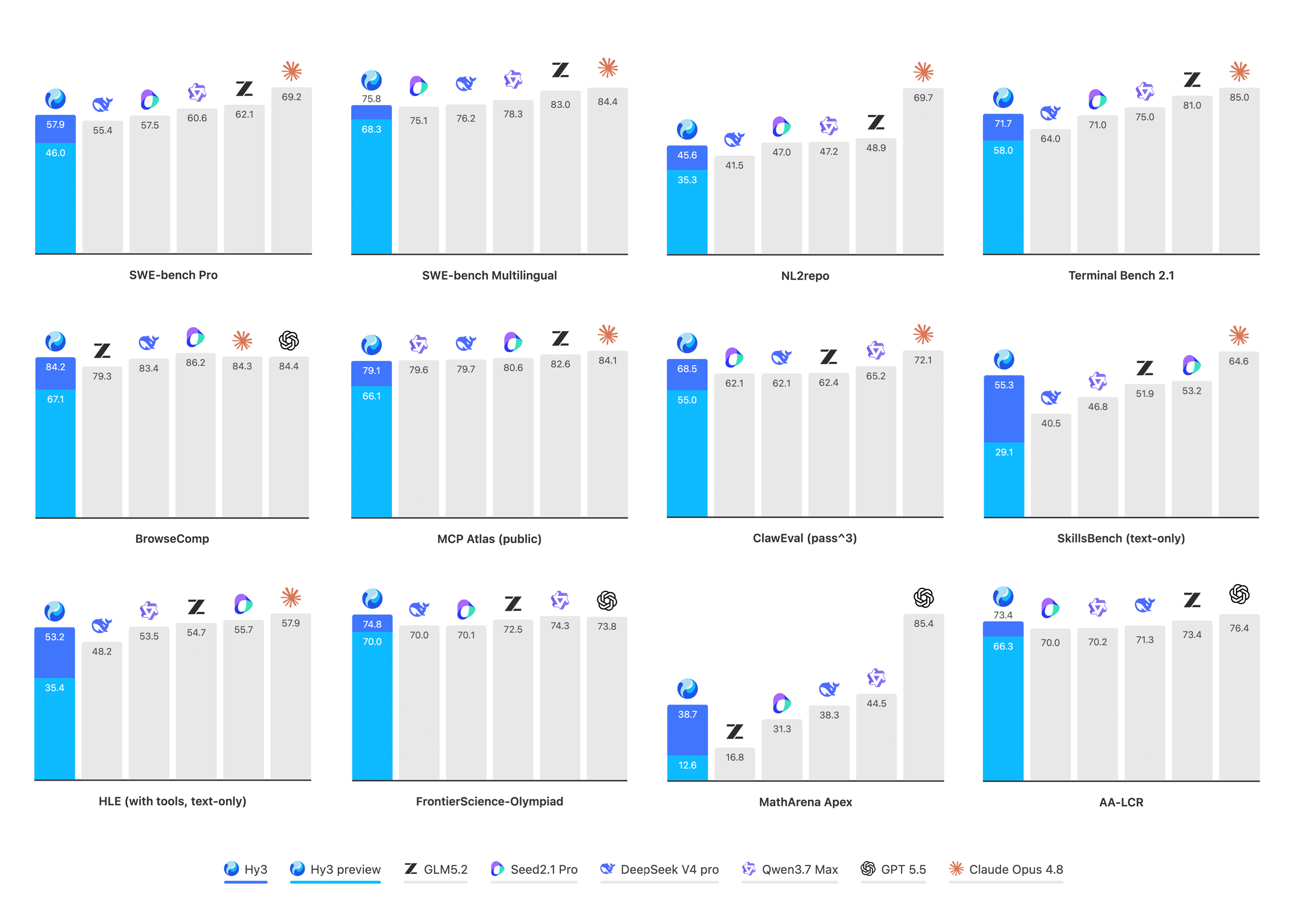
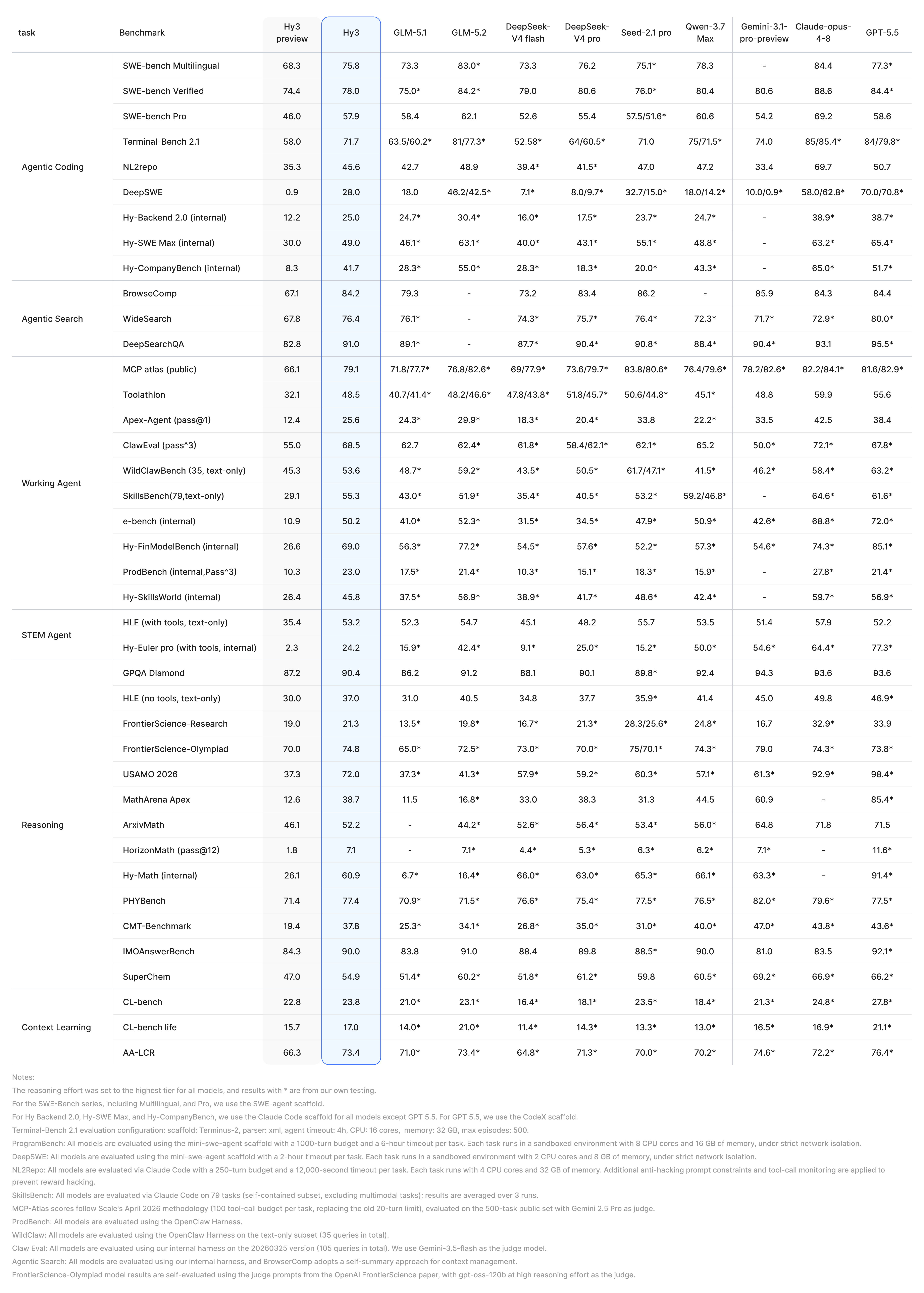
The team's overall conclusion: Hy3 shows "solid gains" in reasoning, agentic workflows, and long-context tasks, with performance approaching leading flagship models at home and abroad. For productivity scenarios — coding, document processing, financial analysis, game development, frontend design — Hy3 is positioned as a "reliable and cost-effective" option.
Real-Workflow Blind Evaluation: 270 Experts, 312 Comparisons

Beyond public benchmarks, the team also ran a blind evaluation on real workflows:
- Participants: 270 experts across different disciplines
- Valid comparisons: 312 pairs
- Scoring: 4-point scale
| Model | Score |
|---|---|
| Hy3 | 2.67 / 4 |
| GLM-5.1 | 2.51 / 4 |
The team reports that Hy3's advantages are most pronounced in frontend development, CI/CD, and data & storage.
3. Production Experience: More Reliable, More Cost-Effective
The team emphasizes that public benchmarks don't fully capture the production experience. Drawing on user feedback and product telemetry, they made targeted fixes to several behaviors that degrade the user experience, and received positive feedback from product teams.
Output Format and Tool-Call Stability
Multiple baseline reliability issues were fixed, raising the model to production-grade across tool configurations and output constraints:
- Higher tool-call success rate and better error recovery
- Fewer invalid calls that trigger infinite loops
- Generalizes well across agent scaffolds
On SWE-Bench Verified, accuracy varies by less than 4% across scaffolds including CodeBuddy, Cline, and KiloCode.
World Knowledge and Hallucination Mitigation

The team treats internal knowledge and external hallucination as interconnected, systemic issues. The goal: "answer when there's evidence, say so when there isn't, never conflate sources, never fabricate data." They applied fine-grained data cleaning and training constraints toward this end.
| Metric | Before | After |
|---|---|---|
| Hallucination rate | 12.5% | 5.4% |
| Common-sense error rate | 25.4% | 12.7% |
These improvements significantly reduced confusing facts, content fabrication, and logical contradictions.
Complex Context Retention and Multi-Turn Intent Tracking
Through joint optimization of Supervised Fine-Tuning (SFT) and Reinforcement Learning (RL), Hy3 improved on engineering pain points like coreference resolution, recovering omitted references, and multi-turn constraint inheritance. In internal comprehensive multi-turn tests, the issue rate dropped from 17.4% to 7.9%. On the open-source long-conversation benchmark MRCR, performance rose from 42.9% to 75.1%.
Output is more concise overall, and complex intent no longer degrades or drifts over long-horizon interactions.
4. Open Source and Model Weights
| Model | Description | Availability |
|---|---|---|
| Hy3 | Instruct model | HuggingFace / ModelScope / GitCode / CNB |
| Hy3-FP8 | FP8 quantized Instruct model | HuggingFace / ModelScope / GitCode / CNB |
Licensed under Apache License 2.0.
5. API Pricing and Limits
Tencent Cloud's Hunyuan API has launched the official Hy3 release. Hy3 offers three thinking modes: no_think (ultra-fast response), think_low (fast thinking), and think_high (deep reasoning), letting users trade off between response speed, reasoning depth, and call cost.
Pricing
| Billing item | Price (RMB / million tokens) |
|---|---|
| Input | 1.0 |
| Cache hit | 0.25 |
| Output | 4.0 |
Supported Capabilities
- Deep reasoning (think_high)
- Function Calling
- Structured output
- Cache
Both input and output use text format.
Rate Limits
| Limit | Value |
|---|---|
| Max input tokens | 192K |
| Max output tokens | 128K |
| Context window | 256K |
| Max TPM | 1,000,000 |
| Max QPM | 60 |
References
- HuggingFace weights: https://huggingface.co/tencent/Hy3
- Hy3-FP8: https://huggingface.co/tencent/Hy3-FP8
- ModelScope: https://modelscope.cn/models/Tencent-Hunyuan/Hy3
- GitCode: https://ai.gitcode.com/tencent_hunyuan/Hy3
- CNB: https://cnb.cool/ai-models/tencent/Hy3
- GitHub: https://github.com/Tencent-Hunyuan/Hy3
- Official site: https://aistudio.tencent.com/
- Contact: hunyuan_opensource@tencent.com